Explore a comprehensive visual framework showing how modern marketing departments function as profit centers.
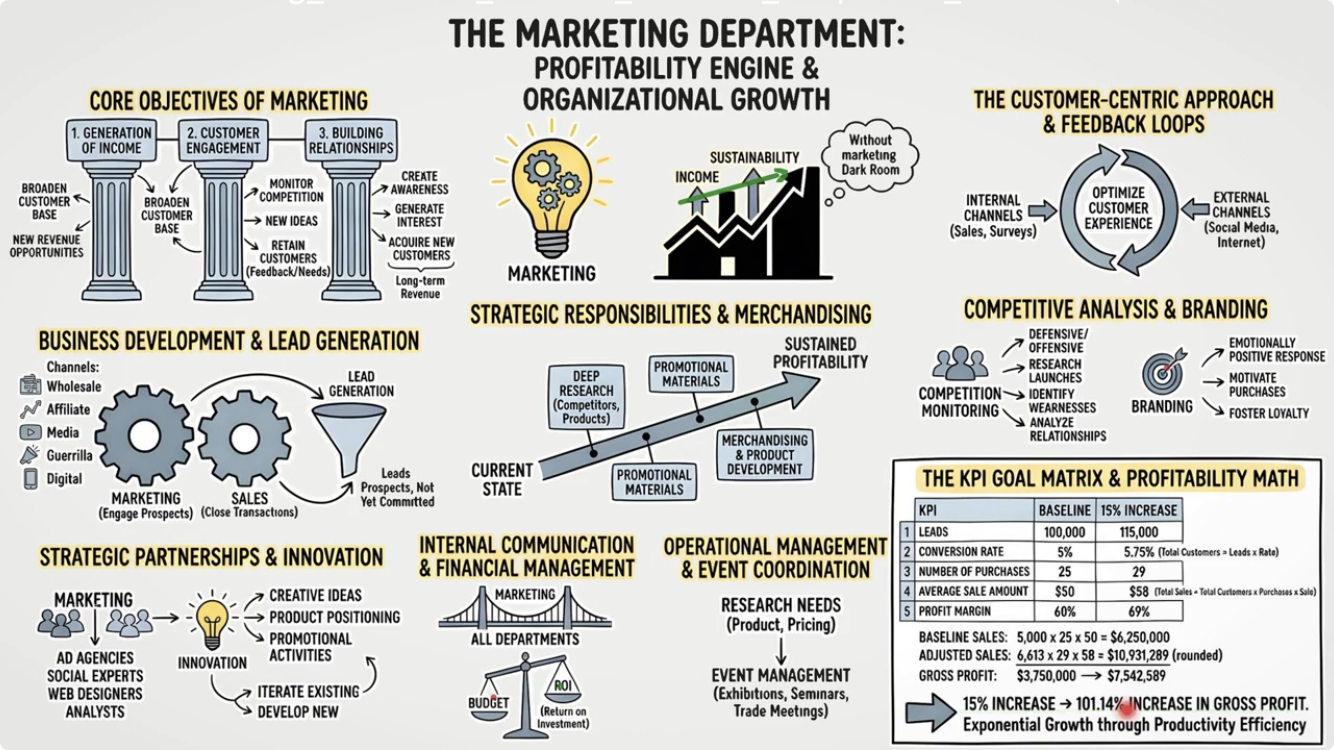
The Marketing Department: Profitability Engine & Organizational Growth Core Objectives of Marketing: The marketing department operates on three fundamental pillars: Generation of Income through broadening customer base and new revenue opportunities; Customer Engagement by monitoring competition and creating interest to acquire new customers with feedback and needs; and Building Relationships by creating awareness and generating long-term revenue. The Marketing Department as a Profitability Engine: Marketing serves as the profitability engine and organizational growth driver. With sustainability and income growth as key metrics, the department strategically positions the organization for success without operating in a dark room, ensuring visibility and measurable results. Strategic Responsibilities & Merchandising: The department manages deep research on competitors and products, develops promotional materials, and handles merchandising and product development. These elements work together to move from the current state to sustained profitability through strategic planning and execution. Business Development & Lead Generation: Marketing utilizes multiple channels including wholesale, affiliate, media, guerrilla, and digital approaches. The lead generation funnel converts prospects and leads into prospects, not yet committed, and finally into sales, closing transactions. This systematic approach ensures consistent pipeline development. Strategic Partnerships & Innovation: Through collaboration with ad agencies, social experts, and web designers, the marketing department generates creative ideas for product positioning and promotional activities. Innovation involves iterating on existing approaches and developing new strategies to maintain competitive advantage. Internal Communication & Financial Management: All departments benefit from internal communication and financial management oversight. The budget and Return on Investment considerations ensure that marketing initiatives are fiscally responsible and contribute to overall organizational profitability. The Customer-Centric Approach & Feedback Loops: Optimization of customer experience occurs through internal channels like sales and surveys, as well as external channels including social media and the internet. This dual feedback mechanism enables continuous improvement and customer satisfaction. Competitive Analysis & Branding: Competitive monitoring involves defensive and offensive research to identify weaknesses and analyze relationships. Branding translates competitive advantages into emotionally positive responses that motivate purchases and foster customer loyalty. Operational Management & Event Coordination: Research needs inform product and pricing decisions. Event management encompasses exhibitions, seminars, and trade meetings that provide platforms for customer engagement and brand visibility. The KPI Goal Matrix & Profitability Math: The department tracks five key performance indicators: Leads baseline of 100,000 with a 15% increase target to 115,000; Conversion Rate at 5% baseline with a 5.75% increase target; Number of Purchases baseline of 25 with a target of 29; Average Sale Amount at $50 baseline with a $58 target; and Profit Margin at 60% baseline maintained. Profitability Calculation: Baseline sales calculation: 5,000 times 25 times 50 equals $6,250,000 in baseline sales. Adjusted sales with 15% increase applied: 6,613 times 29 times 58 equals $10,931,289 rounded. Gross profit increases from $3,750,000 to $7,542,589, representing a 15% increase that translates to 101.14% increase in gross profit, demonstrating exponential growth through productivity efficiency. This framework demonstrates how strategic marketing initiatives, data-driven decision making, and operational excellence work together to drive substantial organizational growth and profitability.