Explore our collection of articles on systems thinking and holistic startup management.
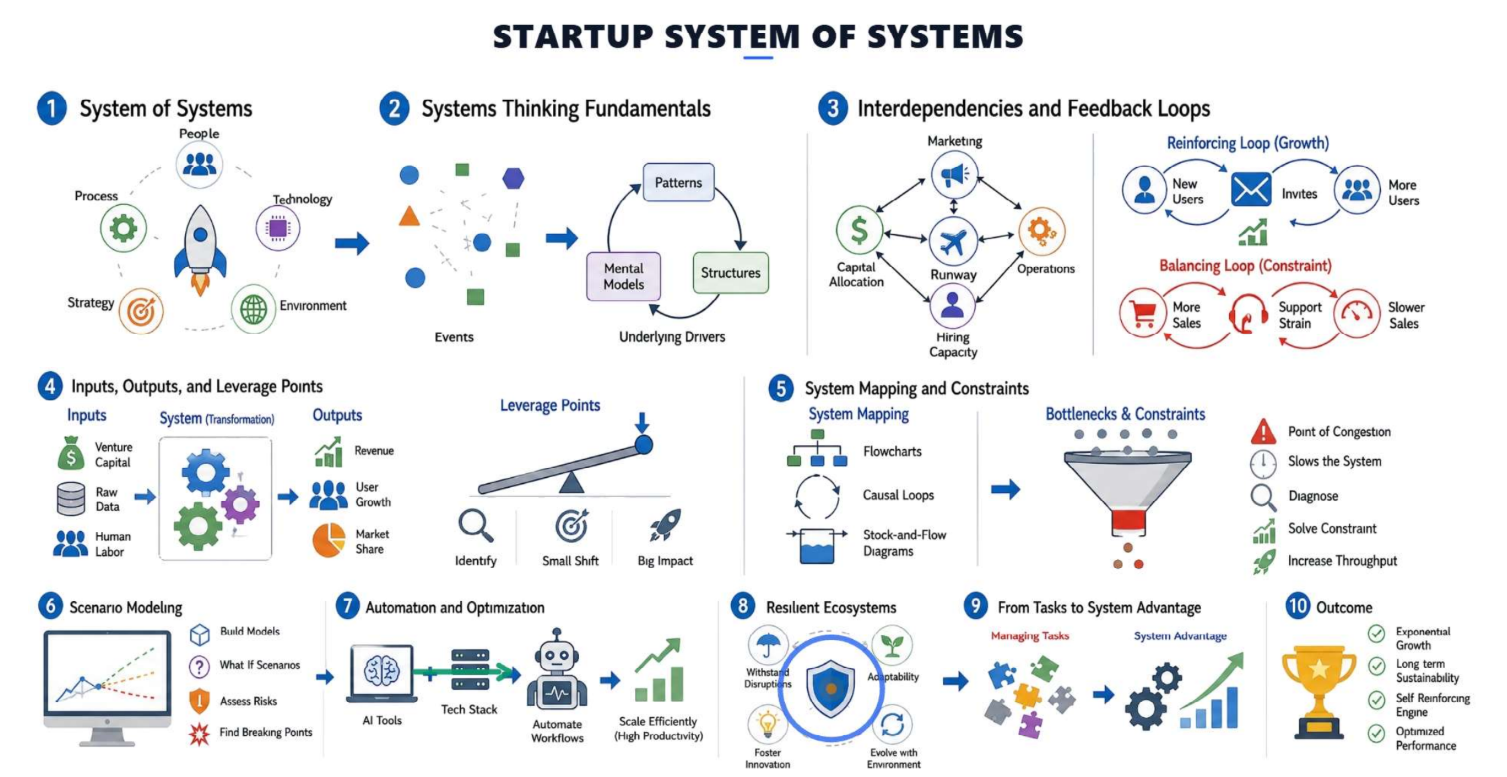
Startup System of Systems The trajectory of a startup is rarely determined by isolated decisions but rather by the collective behavior of its internal and external components. This System of Systems framework treats holistic startup management as a series of interconnected processes rather than independent departments. Systems Thinking Fundamentals serve as the theoretical baseline for this approach. In this context, a system is a set of interacting parts forming a complex whole. For a builder, this means shifting focus from individual events to the underlying patterns and structures that drive success. By analyzing how processes influence one another, you can predict how a change in engineering velocity, for example, will eventually impact customer acquisition. Effective startup management requires mapping Interdependencies to eliminate silos. Functions like capital allocation, marketing strategy, and operations are deeply linked, as illustrated in this interconnected network. Marketing spend affects capital runway, which dictates hiring capacity. Recognizing this allows for proactive coordination. These interdependencies are regulated by Feedback Loops. There are two primary types: reinforcing loops that drive exponential change, like a viral loop where new users invite more users, and balancing loops that act as constraints. For instance, as sales increase, the strain on support grows, eventually slowing down sales if unaddressed. Leveraging these loops drives sustained innovation. Optimizing a business requires clear identification of Inputs and Outputs. Inputs are resources injected like capital or data, while Outputs are measurable results like revenue and market share. Efficiency maximizes outputs relative to inputs. Within these transformations are Leverage Points, where a small shift produces massive changes. Visualizing these relationships happens through System Mapping. Using flowcharts, causal loops, and stock-and-flow diagrams makes abstract processes tangible. Through mapping, you identify Bottlenecks and Constraints that slow the process, allowing you to solve the constraint and increase throughput. Decision-making is supported by Scenario Modeling, simulating what-if scenarios to assess risks before they occur. The system's scalability relies on Automation and Optimization, utilizing AI tools to handle repetitive workflows. Ultimately, the goal is creating Resilient Ecosystems designed for adaptability, acting as a shield against disruptions. The payoff of this systematic approach is the transition from managing a collection of tasks to overseeing a self-reinforcing, optimized engine capable of exponential growth and long-term sustainability. This structured mindset is what truly separates enduring companies from fleeting ideas.
Understanding systems theory and how interconnected processes drive startup success.
Mapping relationships between business functions (capital, marketing, operations) to eliminate silos.
Leveraging reinforcing and balancing loops to drive innovation and efficiency.
Identifying key business inputs (resources, data) and outputs (revenue, user growth) for optimization.
Recognizing high-impact areas within a system that can unlock exponential growth.
Using flowcharts, causal loops, and stock-and-flow diagrams to visualize and refine processes.
Diagnosing process inefficiencies and implementing solutions to streamline operations.
Building predictive models to stress-test strategies and assess risks.
Integrating AI tools and tech stacks to automate workflows and increase productivity.
Designing adaptable systems that can withstand market disruptions and foster innovation.