Explore strategies for optimizing your business operations, from lean methodologies to scalability planning.
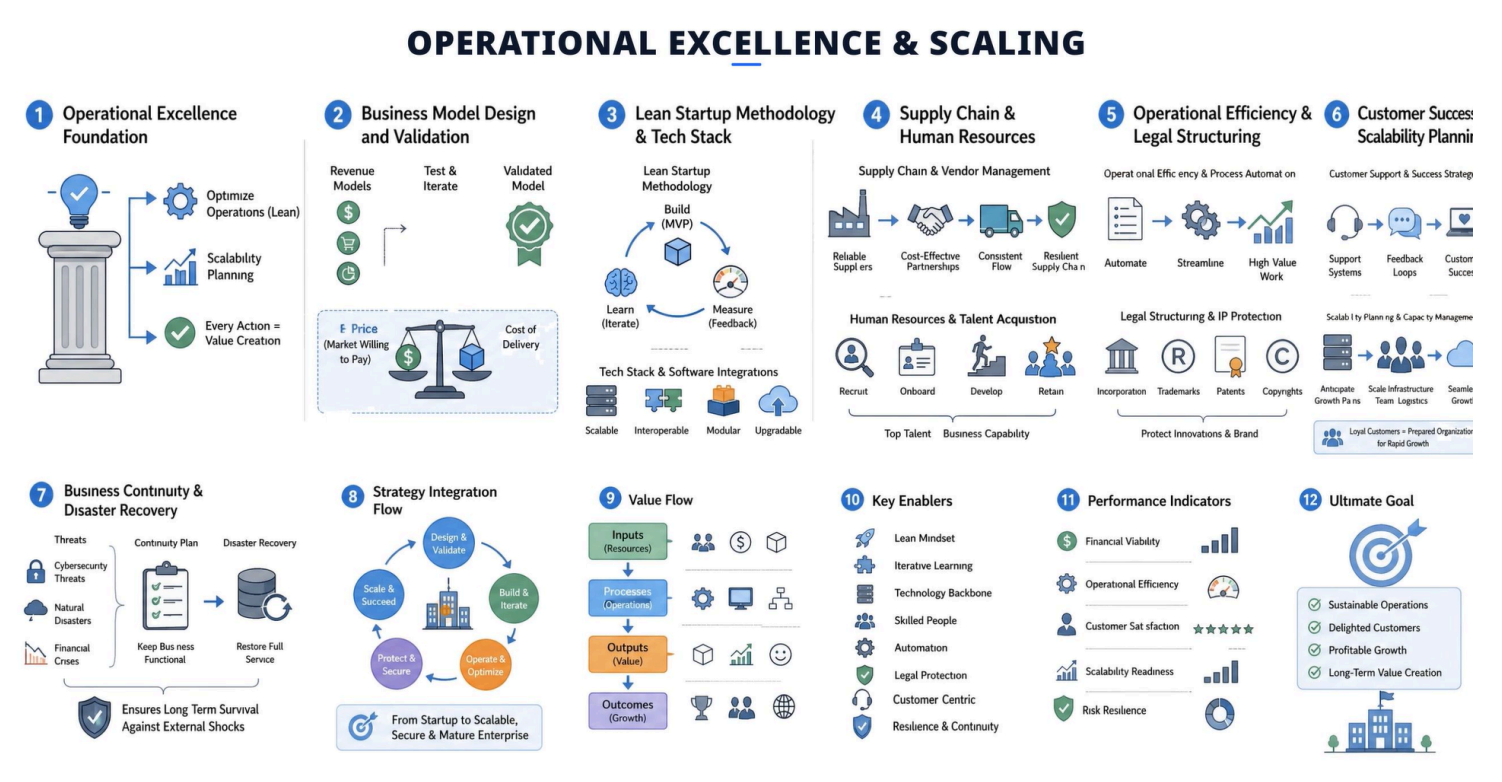
Operational Excellence and Scaling Operational excellence serves as the foundation for transforming a conceptual value proposition into a functional enterprise. This process begins with optimizing business operations through lean methodologies and scalability planning, ensuring that every internal action contributes directly to value creation without unnecessary waste. Business Model Design and Validation: This involves identifying potential revenue models and subjecting them to rigorous testing and iteration. A sustainable revenue model is not merely a method of charging customers; it is a validated framework that confirms the market is willing to pay at a price point that exceeds the cost of delivery. By iterating on these models early, a business avoids the risk of building infrastructure for a product that cannot achieve financial viability. Lean Startup Methodology: Operational strategies focus on the transition from theory to a repeatable, sustainable system. The Lean Startup Methodology provides a framework for execution that prioritizes rapid prototyping and the development of a Minimum Viable Product, or MVP. The objective is to enter the market quickly with a core feature set to gather continuous feedback from actual users. This feedback loop informs the next iteration, ensuring that development resources are only spent on features that solve real user problems. Tech Stack and Software Integrations: Supporting this iterative development is the selection of a Tech Stack and Software Integrations. Building a scalable infrastructure requires choosing tools and platforms that can grow alongside the user base. The focus is on interoperability, ensuring that different software components communicate effectively, and modularity, which allows for parts of the system to be upgraded or replaced without disrupting the entire operation. The combination of lean principles and a robust tech stack allows a company to remain agile while maintaining the capacity for technical growth. Supply Chain and Vendor Management: External and internal resource management is handled through Supply Chain and Vendor Management alongside Human Resources and Talent Acquisition. A resilient supply chain is built on cost-effective supplier relationships that can withstand market fluctuations. This involves diversifying vendors to avoid single points of failure and negotiating terms that ensure a consistent flow of materials or services. Human Resources and Talent Acquisition: Internally, the focus shifts to the human element of the business. Human Resources involves the strategic recruiting, onboarding, and retention of top talent. Because a business is defined by the capabilities of its people, establishing a culture and a compensation structure that attracts high-performing individuals is essential for long-term stability. Managing these two pillars effectively ensures that both the physical and intellectual requirements of the business are consistently met. Operational Efficiency and Process Automation: Operational Efficiency and Process Automation are the primary methods for reducing manual bottlenecks within a workflow. By identifying repetitive tasks and applying automation software, a business can redirect its human capital toward high-value strategic work. Streamlining these workflows is necessary to maintain margins as the volume of work increases. Legal Structuring and IP Protection: In parallel, the business must establish its Legal Structuring and Intellectual Property Protection. This includes the formal process of incorporation, the registration of trademarks, and the securing of patents or copyrights. These legal safeguards protect the company's unique innovations and brand identity from infringement, creating a moat around the business's competitive advantages. Efficiency scales the business, while legal structuring protects the assets created by that scale. Customer Support and Success Strategies: Maintaining the market's trust requires robust Customer Support and Success Strategies. This involves building responsive support systems and feedback loops that allow the company to address user issues and integrate customer suggestions back into the product development cycle. Success strategies move beyond simple troubleshooting to ensure the customer achieves their desired outcome using the product. Scalability Planning and Capacity Management: As the customer base grows, Scalability Planning and Capacity Management become the primary focus. This involves anticipating growth pains, the specific points where existing systems will break under increased load. Whether it is scaling the technical infrastructure, expanding the logistics network, or growing the size of the team, capacity management ensures that the transition to a larger market presence is seamless and does not degrade the quality of service. The goal is to foster a loyal customer base while proactively preparing the organization for the stresses of rapid growth. Business Continuity and Disaster Recovery: The final layer of operational strategy is Business Continuity and Disaster Recovery. This covers the preparation for unforeseen events, including cybersecurity threats, natural disasters, and financial crises. A continuity plan outlines the specific protocols to be followed to keep the business functional during a disruption, while disaster recovery focuses on the technical and operational steps required to restore full service after an event occurs. By planning for these contingencies, a business ensures its long-term survival against external shocks. Comprehensive Operational Strategy: This comprehensive approach to operations moves from initial design and lean testing to automated, protected, and resilient systems. This provides the framework necessary to build and sustain a modern enterprise. The integration of these strategies allows an organization to move from an experimental startup phase to a mature, scalable, and secure operation.
Identifying, testing, and iterating sustainable revenue models.
Rapid prototyping, MVP development, and continuous feedback.
Building a scalable infrastructure with the right tools and platforms.
Creating resilient, cost-effective supplier relationships.
Recruiting, onboarding, and retaining top talent.
Streamlining workflows to reduce manual bottlenecks.
Incorporating, registering trademarks, and securing intellectual property.
Building responsive support systems and feedback loops.
Anticipating growth pains and scaling teams, tech, and logistics.
Preparing for cybersecurity threats, natural disasters, and financial crises.