Learn about effective marketing strategies, growth hacking, and customer acquisition for startups.
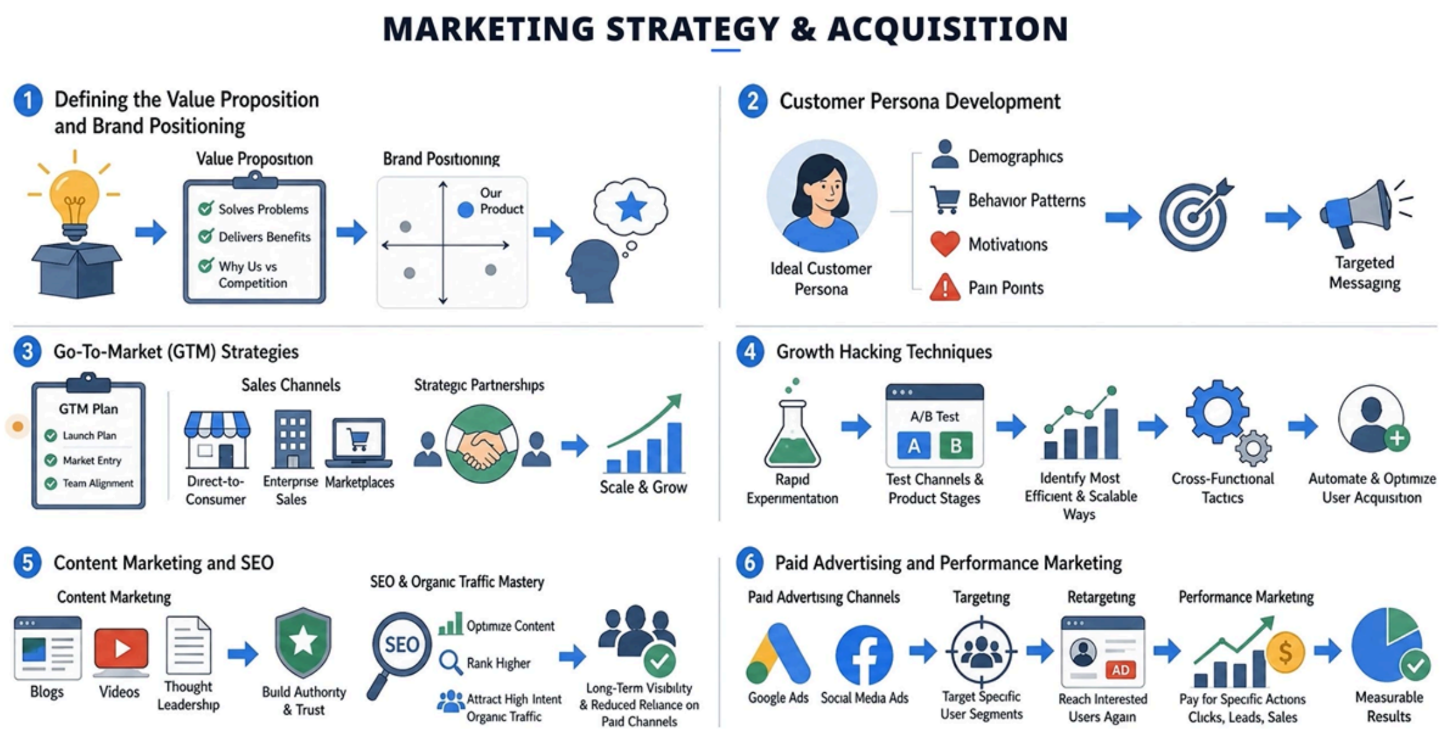
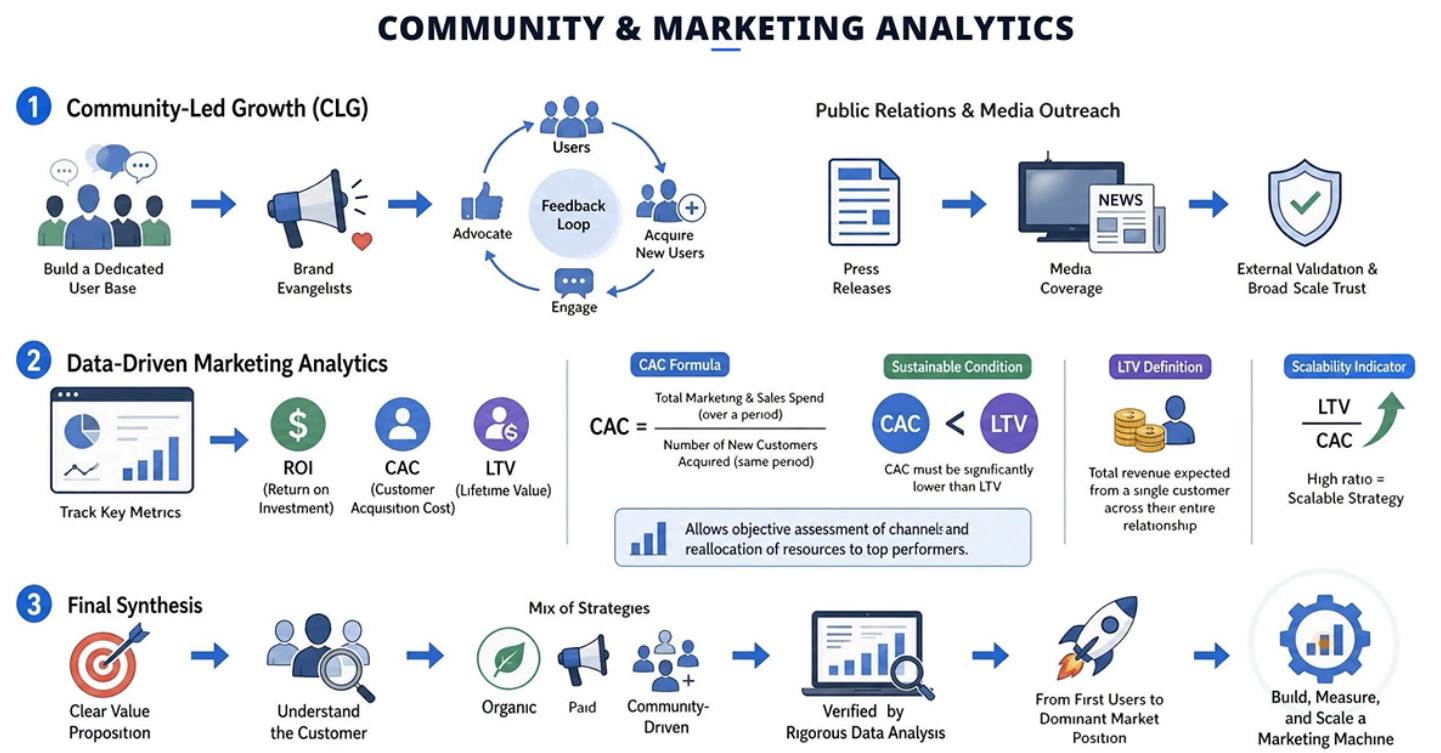
Marketing Strategy and Acquisition The survival of a startup depends less on the product itself and more on the ability to reach and retain the right users. Marketing, in this context, is the systematic process of identifying, reaching, and converting a target audience into loyal customers through growth hacking and strategic acquisition. The foundation of this entire process begins right here with Defining the Value Proposition and Brand Positioning. A value proposition is a concise statement that explains how a product solves a customer's problems, delivers specific benefits, and tells the ideal customer why they should choose you over the competition. You can think of this as a checklist of your core promises. Brand positioning then takes that value and dictates where your product sits in the mind of the consumer relative to all the other alternatives out there. Successful marketing always begins by clearly articulating this unique value. But effective communication requires a specific recipient. That's established through Customer Persona Development. This involves creating highly detailed, research-based profiles of your ideal target audience. We build this ideal customer persona by gathering data on demographic data, behavioral patterns, and their underlying motivations. Crucially, by understanding their specific pain points, your marketing efforts can be tailored to address their unique needs. This allows you to deploy highly targeted messaging rather than broadcasting a generic, easily ignored message to a broad audience. Once your message and audience are perfectly defined, you need an operational roadmap for the product launch. This is your Go-To-Market, or GTM, strategy. This comprehensive plan ensures that internal teams are aligned. It encompasses the selection of your specific sales channels—whether you are going direct-to-consumer, tackling enterprise sales, or utilizing third-party marketplaces. It also involves the establishment of strategic partnerships to scale the product effectively within the competitive landscape. For startups operating with limited resources, you need a framework for rapid scaling. This is where Growth Hacking Techniques come into play. Growth hacking prioritizes data and rapid experimentation—symbolized by this chemistry flask—across various marketing channels and product stages. The goal is to run tests, like these A-B tests, to identify the most efficient and scalable ways to grow the business. It often relies on cross-functional tactics that combine marketing, data analysis, and engineering to fully automate and optimize user acquisition using unconventional, low-cost methods. Now, while growth hacking finds quick wins, building long-term authority and trust is achieved through Content Marketing and SEO. Content marketing involves the continuous creation and distribution of valuable material, such as blogs, videos, and thought leadership pieces. This builds immense credibility. This content is directly supported by SEO, or Search Engine Optimization, which ensures your digital content ranks higher in search results. High rankings improve long-term online visibility and reduce your reliance on paid channels because you are naturally drawing in users who are actively searching for solutions. However, while organic strategies build exceptional long-term value, Paid Advertising and Performance Marketing provide immediate, highly scalable reach. This involves leveraging platforms like Google Ads and social media to surgically target specific user segments. A vital component of this is retargeting, which shows ads to users who have previously interacted with your brand but didn't convert on the first try. And because this is performance marketing, it is strictly results-oriented; you only pay for specific, measurable actions like clicks, leads, or sales. Ultimately, mastering startup marketing requires a balanced approach: you must build a strong organic foundation based on true value, while selectively using rapid experimentation and paid channels to ignite immediate, measurable growth. As we look beyond initial acquisition, sustainable growth is often further reinforced by turning these acquired users into dedicated brand evangelists through Community-Led Growth. Community and Marketing Analytics Now, let's explore how sustainable growth is often reinforced. It primarily happens through two main avenues: Community-Led Growth, or CLG, and Public Relations and Media Outreach. Starting with CLG, the core focus here is on building a highly dedicated user base. These aren't just casual users; they act as passionate brand evangelists. By actively fostering online communities and encouraging social engagement, the brand creates a powerful, self-sustaining feedback loop. Within this loop, your existing users actually help you acquire new users, constantly fueling growth. Complementing this grassroots approach is Public Relations. This involves actively managing the brand's reputation and narrative. You do this through strategic press releases and by securing positive media coverage. Why is this important? Because it builds a level of external validation and broad-scale trust that traditional, paid advertising simply cannot easily replicate. So, to summarize this top section: Community-led growth turns your everyday users into vocal advocates, while PR builds that essential institutional trust through third-party media validation. Moving down to the next level, the final and arguably most critical component to tie all this together is Data-Driven Marketing Analytics. This is what allows a startup to truly quantify its success and know what's working. We focus on tracking three primary metrics: Return on Investment, or ROI, Customer Acquisition Cost, or CAC, and Lifetime Value, or LTV. Let's look at how we calculate the Customer Acquisition Cost, or CAC. You figure this out by taking the total marketing and sales spend over a specific period and dividing it by the number of new customers acquired in that exact same period. It tells you exactly how much you paid to get one new user. Now, for a startup's growth to actually be sustainable, we have a golden rule: your CAC must be significantly lower than your Lifetime Value. But what is Lifetime Value? LTV is the total revenue a business can reasonably expect from a single customer throughout their entire relationship with the company. When you compare these two, you get a powerful indicator of scalability. If the ratio of LTV to CAC is high, it means you're making much more from a customer than it costs to acquire them, proving your marketing strategy is highly scalable. Ultimately, tracking these analytics allows for the objective assessment of which channels are performing best, telling you exactly where your resources should be reallocated. In short, marketing analytics provide the undeniable mathematical proof of a strategy's effectiveness by simply comparing the cost of getting a customer to the total value that customer brings in. Bringing it all together in our final synthesis: mastering all these components transforms your marketing from a series of scattered, disjointed efforts into a powerful, cohesive growth engine. It starts by defining a clear value proposition, thoroughly understanding the customer, and then utilizing a smart mix of organic, paid, and community-driven strategies. When all of this is verified by rigorous data analysis, a startup can successfully transition from its very first few users to holding a dominant market position. By following these interconnected steps, you now have the complete framework to build, measure, and scale a truly comprehensive marketing machine.
Crafting a clear, compelling message that sets you apart.
Identifying and understanding your ideal target audiences.
Roadmaps for product launches, sales channels, and partnerships.
Rapid experimentation across marketing channels to identify scalable strategies.
Using blogs, videos, and thought leadership to build credibility.
Leveraging Google Ads, social media ads, and retargeting strategies.
Improving search rankings and building long-term online visibility.
Building brand evangelists through online communities and social engagement.
Crafting press releases, securing media coverage, and managing brand reputation.
Tracking ROI, customer acquisition costs (CAC), and lifetime value (LTV).