Explore our collection of articles on startup funding, financial strategies, and capital management.
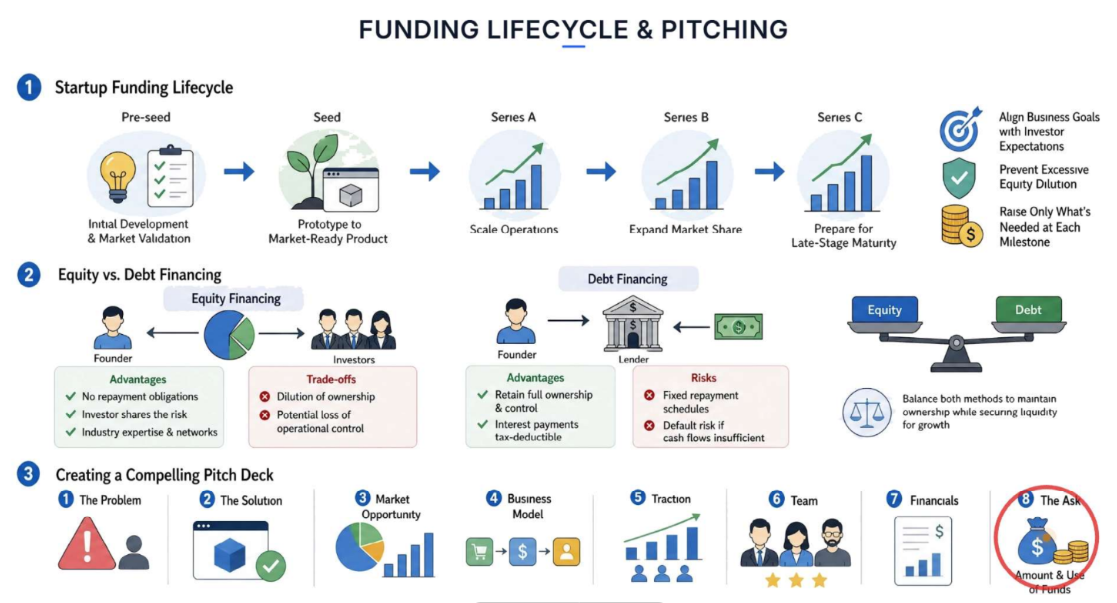
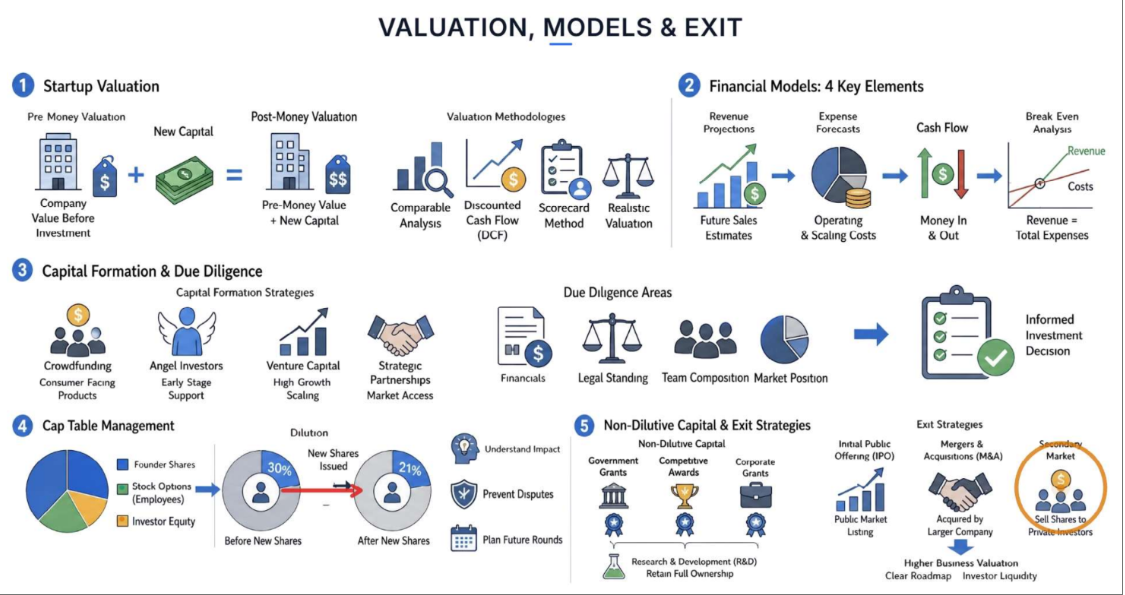
Funding Lifecycle and Pitching Securing capital is the primary engine that transforms a conceptual idea into a scalable enterprise. For a founder, capital management is not merely about obtaining funds, but about strategic timing and alignment with the specific growth phase of your business. Let's trace the lifecycle of startup funding. It all begins right here at the Pre-seed stage. At this point, your focus is entirely on initial development and validating that a market actually exists for your idea. Once you've got that, you move to the Seed stage, which typically provides the funds needed to transition your early prototype into a market-ready product. As the company demonstrates real traction, it progresses into Series A, B, and C rounds. These distinct phases are designed for scaling operations, aggressively expanding market share, and finally preparing for late-stage maturity. Taking this step-by-step approach is vital because it helps you prevent excessive equity dilution. You are raising only what is strictly necessary to reach the next milestone. Equity and Debt Financing A fundamental decision in your capital strategy is choosing between Equity and Debt financing. Let's look at Equity Financing first. This involves selling a slice of the business to investors. The primary advantage is that there are no repayment obligations; the investor assumes the risk right alongside you. Plus, they often bring valuable industry expertise. However, the trade-off is giving up a portion of ownership and potentially losing some operational control over your own company. On the other hand, we have Debt Financing. This involves borrowing capital from a lender, like a bank, which must be repaid with interest. The major benefit here is that founders retain complete ownership and control. The main risks, however, are the pressure of fixed repayment schedules and the danger of defaulting if your cash flows dry up. Ultimately, you want to balance both methods to maintain your ownership while still securing the liquidity needed to grow. Pitch Deck Essentials Now, to secure this funding, your pitch deck serves as the visual narrative of your startup's potential. It has to be comprehensive yet concise. A compelling deck must clearly outline The Problem you are solving in the market. Next, present The Solution - your unique value proposition. You must also define the Market Opportunity and size, followed by your Business Model, which explains how you will generate revenue. Don't forget to prove your momentum with Traction, introduce your capable Team, lay out your historical and projected Financials, and most importantly, conclude with The Ask - the specific amount of capital you are seeking and exactly how you plan to use it. Mastering this narrative positions you perfectly for investor discussions. Valuation, Models and Exit Startup valuation is a critical negotiation tool that combines qualitative and quantitative analysis to figure out what your company is worth. Understanding the distinction between pre-money valuation and post-money valuation is essential. Pre-money valuation refers to the company's value before receiving any investment, while post-money valuation is simply that pre-money value plus the new capital raised. Several methodologies are used to reach these figures. Comparable Analysis looks at the valuations of similar companies in your industry. The Discounted Cash Flow, or DCF method, estimates the value of an investment today based on projections of how much money it will generate in the future, adjusted for risk. The Scorecard Method compares the startup to other funded startups, adjusting for factors like the management team. Mastering these methods prevents over- or undervaluation, ensuring realistic fundraising goals. Financial Models and Projections Financial models provide a roadmap for your startup's future profitability. These models have four key elements. Revenue Projections estimate future sales based on market trends. Expense Forecasts detail the costs required to operate and scale. Cash Flow tracks the actual movement of money in and out of the business, ensuring liquidity. Finally, the Break-Even Analysis identifies the exact point where total revenue equals total expenses. These projections guide internal decision-making. Capital Formation Capital formation is the process of aligning business goals with the right funding sources. This might include Crowdfunding for consumer-facing products, Angel Investors for early-stage support, Venture Capital for high-growth scaling, or Strategic Partnerships for market access. Once an investor is interested, we move into Due Diligence. This is an intensive investigation into the startup's Financials, Legal standing, Team composition, and Market position. Proper preparation here speeds up the final investment decision by reducing perceived risk. Final Considerations and Due Diligence So you got an investor interested in your company. Congratulations! There are a couple of key items to think about before you decide to move forward with an investor. Personal Fit: Do you like the person you are working with? Are they someone you would want to sit next to for a long flight? Reputation: What is their reputation in the industry? Do they have a history of being helpful and supportive? Or do they have a history of being difficult? Value Add: What will this investor bring to the table beyond just capital? Do they have a network of contacts that you can tap into? Do they have experience in your industry that they can share with you? Terms: Do you understand the terms of the investment? Are you comfortable with the level of control that the investor will have over your company? Timing: Do you need the capital right now? If not, it might be worth waiting for a better offer. Due diligence is the process of verifying the information that a company has provided to investors. This is typically done by the investor's lawyers and accountants. The due diligence process can be quite extensive, and it can take several weeks or even months to complete. The goal of due diligence is to identify any potential red flags that could make the investment risky. The due diligence process typically involves reviewing Financial Statements, Cap Table, Customer Contracts, Supplier Contracts, Employment Agreements, Intellectual Property, Legal Documents, Insurance Policies, Tax Returns, and Material Agreements. The investor will also likely want to interview members of your team, as well as your customers and suppliers. Once the due diligence process is complete, the investor will decide whether or not to move forward with the investment. If they do, they will typically provide a term sheet, which is a non-binding agreement that outlines the key terms of the investment.
Every startup's journey begins with an idea, but bringing that idea to life often requires funding. Understanding the stages of startup funding is crucial for founders to plan their capital strategy and approach the right investors at the right time.
Startups often face the critical decision of choosing between equity and debt financing. Each method has its pros and cons, and understanding them can determine how much control founders retain over their business.
A pitch deck is your startup's story told visually. Crafting a strong pitch deck is key to securing investor interest and funding.
Startup valuation is both art and science. Understanding how to value your business helps you negotiate with investors and plan for future rounds.
Investors want to see not just where you are but where you're going. Financial models tell the story of your startup's future growth and profitability.
Securing funding is more than pitching investors - it requires a strategy. Capital formation aligns your business goals with potential funding sources.
Due diligence is an investor's deep dive into your startup. Preparing for it shows you are transparent and investment-ready.
A cap table tracks your startup's ownership structure. Mismanaging it can cost founders equity and control.
Grants provide funding without giving up equity. Understanding non-dilutive options can strengthen your financial position.
An exit strategy outlines how founders and investors realize their returns. Planning it early guides your startup's growth.