Exponential Value Creation and Corporate Growth Engine
The CAMO Framework is an exceptionally well-structured and strategically sophisticated content framework. It fundamentally elevates the entire management team to a cohesive system for integrated entrepreneurial execution skill and operational accomplishments.
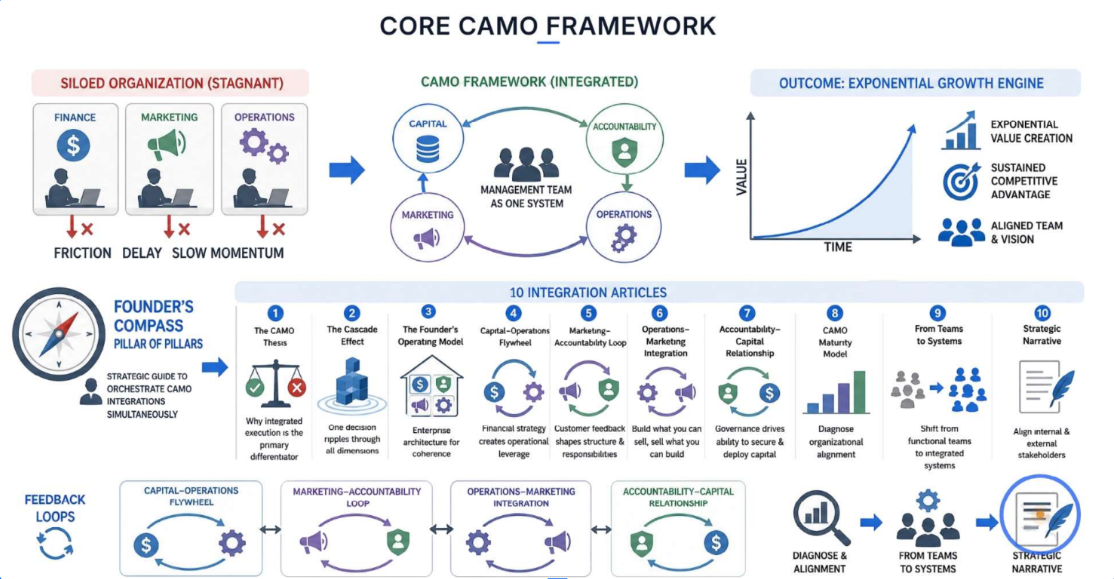
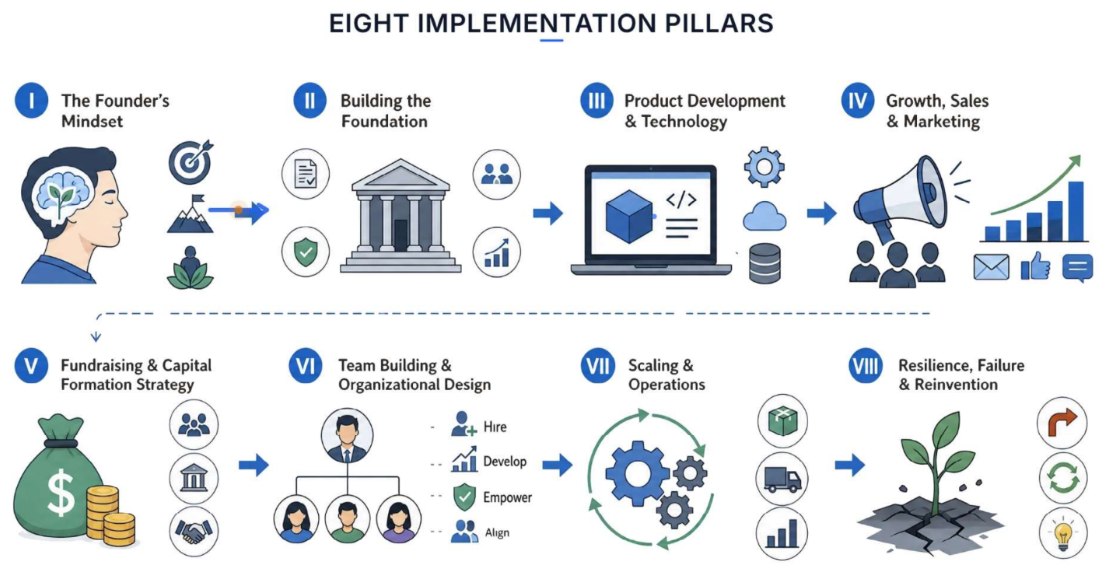
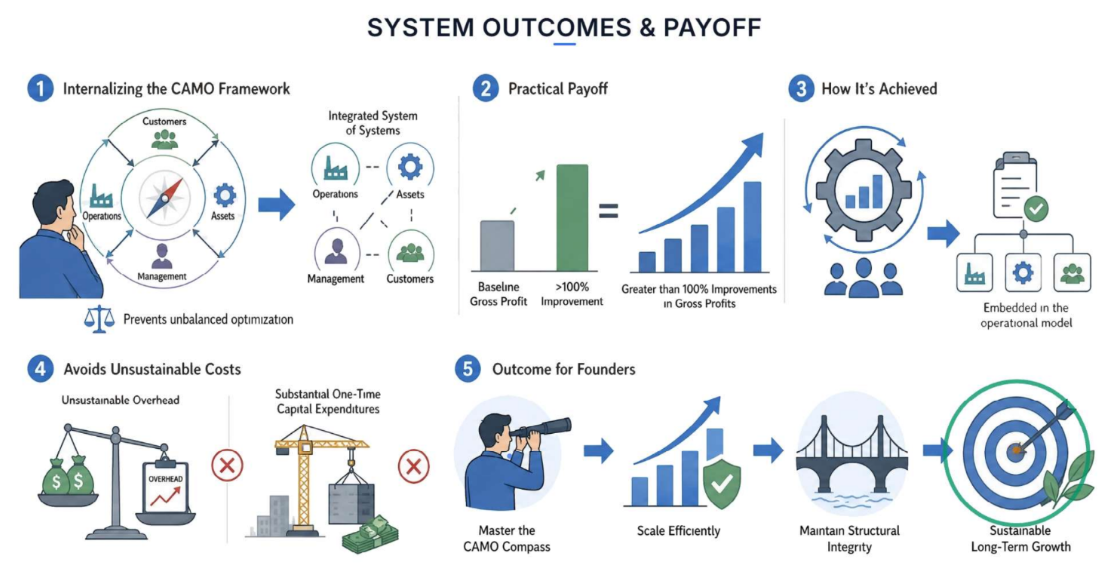
Core CAMO Framework The difference between a stagnant enterprise and an exponential growth engine really comes down to the integration of its core functions. Most organizations operate in silos, where departments like finance, marketing, and operations move completely independently of one another. As you can see, this fragmented approach often creates friction that severely slows momentum. To solve this, we use the CAMO Framework—representing Capital, Accountability, Marketing, and Operations. This framework is specifically designed to dismantle those silos, transforming the management team into a cohesive system for integrated entrepreneurial execution. By synchronizing these four dimensions, a founder can move beyond linear, slow progress to achieve an exponential growth engine. At the very center of this integrated system is the Founder's Compass. We describe this as the Pillar of Pillars, because it's the strategic guide that allows a founder to orchestrate all these CAMO integrations simultaneously. The framework is explored deeply through ten specific integration articles that define exactly how these dimensions interact. We start with The CAMO Thesis, which establishes why integrated execution is the primary differentiator between successful market leaders and those who fail to scale. This naturally leads into The Cascade Effect. This principle posits that a decision made in one dimension—say, a change in your capital structure—will inevitably ripple through your marketing, operations, and accountability structures. Next, The Founder's Operating Model focuses on enterprise architecture, ensuring the organization is designed for coherence rather than just functional output. This coherence is actively maintained through specific feedback loops, which you can see running along the bottom here: First is The Capital-Operations Flywheel. This loop examines how financial strategy is directly used to create operational leverage. Next, The Marketing-Accountability Loop details how customer feedback and market response directly shape your organizational structure and individual responsibilities. Then we have The Operations-Marketing Integration, which ensures the business only builds what it can effectively sell, and vice versa—only sells what it has the operational capacity to build. Finally, The Accountability-Capital Relationship addresses how your governance and internal responsibility structures dictate your ability to secure and effectively deploy funding. To round out the framework, we include tools for assessment and alignment. We use the CAMO Maturity Model to accurately diagnose organizational alignment. We focus heavily on the shift from functional teams to integrated systems. And finally, we emphasize the development of a Strategic Narrative to perfectly align both internal and external stakeholders. With this overarching framework mapped out, we will next explore how to implement this through eight distinct pillars, starting with the internal psychology and mindset of the leader. Eight Implementation Pillars To implement the CAMO Framework effectively, we structure the journey into eight distinct, sequential pillars. This progression naturally moves from the internal psychology of the leader all the way to the external, operational mechanics of the business. Let's begin right here with Pillar I, The Founder's Mindset. This establishes the psychological bedrock required for the journey. From there, we move to Pillar II, Building the Foundation, which puts the necessary structural prerequisites in place. Together, these first two steps ensure your organization is actually capable of sustaining growth. Next, we shift our focus to Pillar III: Product Development and Technology. This serves as your core offering—the actual value you provide to the world. Once that core product is solid, we must drive revenue, bringing us to Pillar IV: Growth, Sales, and Marketing. Notice the upward trajectory we are aiming for here as we take the product to market. Moving into the second phase of the lifecycle, Pillar V is your Fundraising and Capital Formation Strategy. Think of this capital as the essential fuel for your engine. However, fuel is useless without the right mechanics to use it, which is managed through Pillar VI: Team Building and Organizational Design. Here, we design the clear hierarchies and alignment necessary for execution. As operations become more complex, we focus on Pillar VII, Scaling and Operations, ensuring the efficient expansion of these interconnected systems. Finally, the series concludes with Pillar VIII: Resilience, Failure, and Reinvention. Much like a plant breaking through solid concrete, this acknowledges that long-term success requires the agility to adapt, learn from inevitable setbacks, and pivot when the external environment shifts. The fundamental takeaway here is that these pillars must be built in order—you cannot scale operations or drive massive sales if you haven't first established a resilient founder's mindset and a solid structural foundation. Internalizing this step-by-step framework is exactly what allows founders to transition from managing isolated departments to overseeing a truly integrated system of systems. System Outcomes & Payoff Now that we've walked through the pillars, let's look at what happens when you truly internalize the CAMO Framework. Instead of just managing isolated, individual departmental units—like operations, assets, management, and customers acting on their own—you transition to overseeing an integrated system of systems. This holistic approach prevents the common pitfall of unbalanced optimization. You know, those painful situations where improving one department inadvertently harms another. So, what is the actual reward for doing this? The practical payoff is massive. By aligning these systems, you gain the ability to achieve greater than 100% improvements in your gross profits, stepping way up from your baseline. And how is this achieved? It doesn't happen by accident. It is accomplished by building exponential growth mechanisms and ensuring they are completely embedded directly into the operational model of your business. Now, because these improvements are systemic and built right in, you avoid two major growth killers. First, you bypass the trap of unsustainable overhead that usually drags a scaling company down. And second, you eliminate the need for substantial, one-time capital expenditures—those massive cash injections typically required just to kickstart new initiatives. Ultimately, this leads us to the final outcome for founders. When you master this compass, you gain the ability to scale efficiently, while relying on a framework that helps you maintain absolute structural integrity, just like a well-engineered bridge. The most important takeaway here is that by treating your business as an interconnected system rather than a collection of silos, you guarantee sustainable, long-term growth without the chaotic costs of unbalanced scaling.
The Founder's Compass is the "Pillar of Pillars" enabling Founders to employ CAMO integrations that create exponential value when orchestrated together.
Why integrated execution separates winners from also-rans
How decisions in one dimension ripple through all others
Designing enterprise architecture for coherence
How financial strategy enables operational leverage
How customer feedback shapes organizational structure
Building what you can sell, selling what you can build
How governance structure determines funding outcomes
Diagnosing where you're strong, weak, and misaligned
Organizational design that enables CAMO coherence
Articulating your CAMO strategy for internal and external alignment
Pillar I
Pillar II
Pillar III
Pillar IV
Pillar V
Pillar VI
Pillar VII
Pillar VIII
The Founder's Compass delivers exponentially higher value as an integrated system of systems versus a traditional collection of departmentally managed units. Founders and Experienced Entrepreneurs who have internalized the approach are not only preventing the expensive mistakes that come from unbalanced optimization but by embedding the exponential growth creation mechanisms to gross profit they can achieve greater than 100% improvements to gross profits while simultaneously avoiding unsustainable additional overhead expenses which are generally coupled by substantial one time capital expenditures new growth initiatives often must incur.