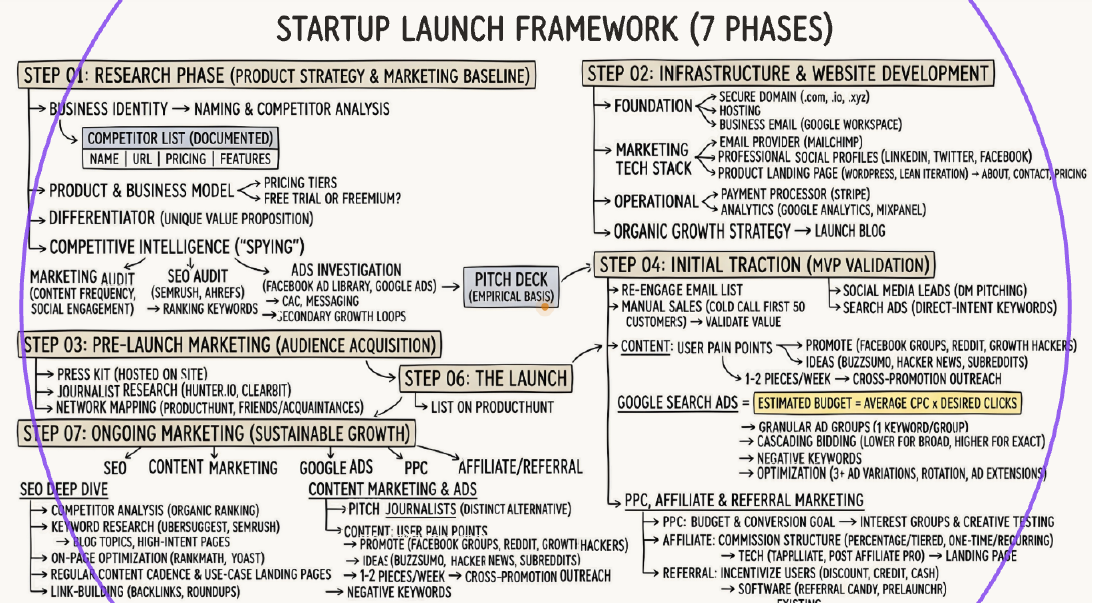
7-Phase Startup Launch Framework
This comprehensive framework outlines the seven critical phases necessary to successfully launch and scale a startup from initial concept to sustainable growth.
PHASE 1: RESEARCH PHASE (Product Strategy & Marketing Baseline)
Begin with establishing your Business Identity through naming and conducting thorough competitor analysis. Document competitor information including URL, pricing, and key features to understand your market position. Define your Product and Business Model by selecting appropriate pricing tiers and determining whether to offer free trials or freemium options. Establish your Differentiator by identifying the unique value proposition that sets you apart from competitors. Conduct comprehensive Competitive Intelligence through marketing audits, SEO analysis using tools like SEMrush and Ahrefs, and competitive ad research via Google Ads and Facebook Ad Library. Verify affiliate and referral program opportunities by examining competitor site footers and conducting targeted searches. Compile all this data into a Pitch Deck if seeking external investment.
PHASE 2: INFRASTRUCTURE & WEBSITE DEVELOPMENT
Establish your Foundation by securing a domain (prioritizing .com, .io, or .xyz extensions) and selecting hosting. Build your Marketing Tech Stack including email providers like MailChimp, social media profiles on LinkedIn, Twitter, and Facebook, and a product landing page built on WordPress for rapid iteration. Set up your Operational Infrastructure with payment processors like Stripe for transactions and analytics tools like Google Analytics or Mixpanel to track user behavior. Establish professional communication through Google Workspace and launch a blog if SEO is central to your strategy.
PHASE 3: PRE-LAUNCH MARKETING (Audience Acquisition)
Create a Press Kit hosted on your website to facilitate journalist engagement and earned media coverage. Conduct Journalist Research using platforms like Hunter.io and Clarity to identify relevant press contacts. Perform Network Mapping to identify ProductHunt, Reddit, Hacker News, and other community influencers relevant to your product. Set up mechanisms for capturing leads through your landing page while offering incentives like discounts or exclusive content rather than just notifications.
PHASE 4: INITIAL TRACTION (MVP Validation)
Re-engage your pre-launch email list as your first customers. Conduct Manual Sales by cold calling your first 50 customers to validate product-market fit in one-on-one interactions. Generate Social Media Leads through direct messaging on platforms like Facebook and LinkedIn. Create compelling Content highlighting user pain points and promote your offering through targeted campaigns on platforms like Facebook Groups, Reddit, Growth Hacker communities, and Hacker News. Implement Google Search Ads with careful budget management through cost-per-click analysis and estimated budgets. Structure your ads with granular keyword grouping, cascade bidding to optimize costs, negative keyword exclusions, and continuous A/B testing with rotation and extensions.
PHASE 5: PHASE 5 - Additional Traction Strategies
Develop PPC, Affiliate and Referral Marketing programs with clear commission structures (percentage/tiered, one-time/recurring). Structure referral programs to incentivize users through discounts, credit, or cash rewards using software like PreLaunch or Candy.
PHASE 6: THE LAUNCH
Execute your go-to-market strategy by listing your product on ProductHunt to reach early adopters and generate initial traction and press coverage.
PHASE 7: ONGOING MARKETING (Sustainable Growth)
Implement SEO Deep Dive strategies including competitor organic ranking analysis, keyword research using tools like Ubersuggest and Semrush, creation of high-intent pages optimized for keywords, on-page SEO using Rankmath or Yoast, regular content cadence, strategic link-building through backlinks and roundups, and comprehensive competitor analysis.
Develop Content Marketing strategies including pitching journalists as thought leaders, content marketing focused on user pain points, and multi-piece content sequences promoting your offering.
Execute PPC and Google Ads strategies with careful budget allocation, conversion optimization, interest-based targeting, creative testing, and continuous optimization across ad variations and extensions. Implement Affiliate/Referral Marketing with clear commission structures, tiered percentages for different performance levels, one-time or recurring incentives, and software solutions like PreLaunch or Candy. Deploy referral programs that incentivize users through credits, discounts, or cash rewards.
Key Takeaways:
1. Choose your primary launch path - either Push (through owned channels) or Pull (through earned media and organic discovery)
2. Align pricing with market positioning and competitor analysis
3. Calculate ASP (Average Selling Price) and manage volume discounts strategically
4. Build strong channel partnerships for distribution
5. Advocate for barriers that protect your competitive position
6. Plan for growth with clear financial projections and defined exit strategies
7. Define the exit strategy most important for investors - public offering, merger, or convertible note