


← Back to Business Plans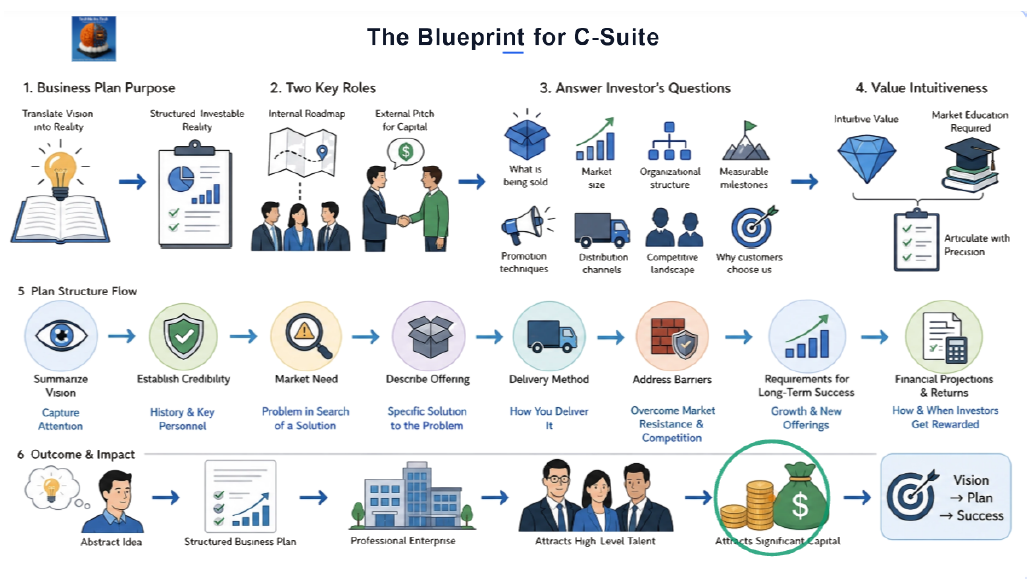
Business Planning Discussion Narrative
A comprehensive framework for business planning principles and strategic discussion
The Blueprint for C-Suite
A business plan is the primary instrument through which an entrepreneur translates a vision into a structured, investable reality. For a C-Suite team, this document serves two roles: an internal roadmap for operational alignment and an external pitch to secure capital. The preparation process forces a founder to answer the difficult questions an investor will inevitably pose. These include identifying exactly what is being sold, the specific size of the market, the organizational structure, and the measurable milestones that define success. Whether the value of the offering is intuitive or requires significant market education, the plan must articulate the promotional techniques, distribution channels, and competitive landscape with absolute precision.
High-level strategy depends on understanding the "so what" of the business—why a customer will choose your offering over every other alternative. To achieve maximum impact, the structure of the plan must be designed to maintain momentum and build credibility. It begins by summarizing the vision to convince the reader to invest their time, followed immediately by establishing the credibility of the enterprise through its history and key personnel. You must demonstrate a clear market need—a problem in search of a solution—before describing your specific offering. This logical flow ensures that by the time you explain your delivery method, the reader already understands the market's hunger for it. A robust plan does not shy away from barriers; instead, it acknowledges potential market resistance and competitive reactions, providing a clear strategy for overcoming them. This leads into the requirements for long-term success, such as handling growth and developing new offerings. Finally, the narrative is anchored by financial projections and an explanation of financial returns, showing exactly how and when investors will see a reward for their risk. This structured approach transforms an abstract idea into a professional enterprise capable of attracting high-level talent and significant capital.
Objectives & Value Proposition
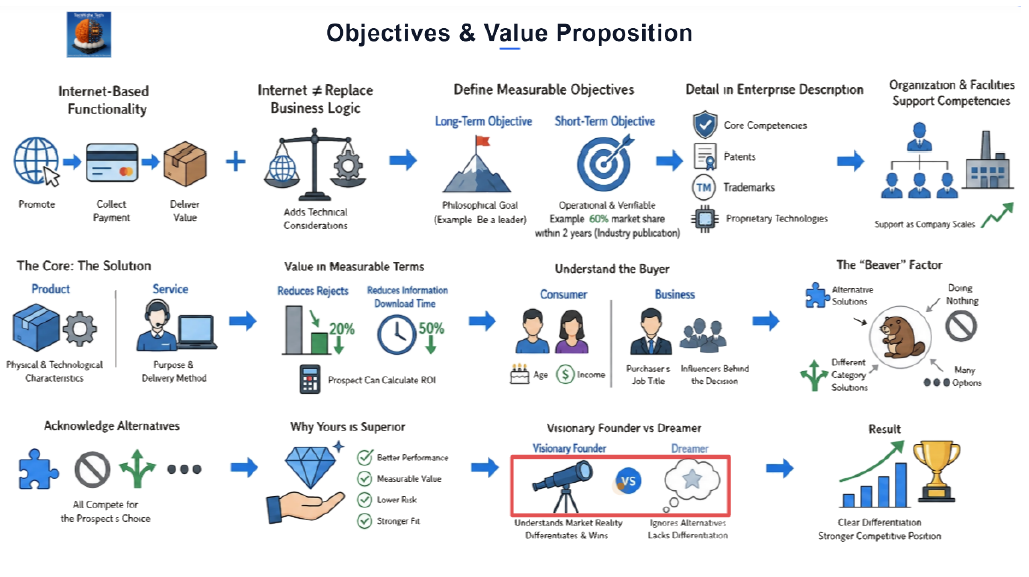
Modern business planning often centers on Internet-based functionality, which offers powerful ways to promote, collect payment, and deliver value. However, the presence of the Internet does not replace the fundamental need for traditional business logic; it merely adds new technical considerations. When documenting the enterprise, start by defining measurable objectives rather than just a grand purpose. A long-term objective is philosophical, such as striving to be a leader in a specific field, while a short-term objective must be operational and verifiable. For example, aiming for a 60% market share within two years as measured by a specific industry publication provides a concrete "measuring stick." This level of detail extends to the enterprise description, where you must highlight core competencies—such as patents, trademarks, or proprietary technologies—that provide a competitive edge. The C-Suite must be able to articulate how the organizational structure and the location of facilities support these competencies as the company scales. The core of the plan is the solution, which must be framed as a direct answer to a market need. If you are offering a product, you must describe its physical and technological characteristics; if it is a service, you define its purpose and delivery method. Crucially, the value must be presented in measurable terms. It is not enough to say a product is "better." You must state, for instance, that it "reduces rejects by 20%" or "reduces information download time by 50%." This specificity allows the prospect to calculate their return on the purchase price. Understanding the buyer is equally vital. For a consumer, this involves demographics like age and income; for a business, it involves the purchaser's job title and the influencers behind the decision. You must also account for the "beaver" factor—the reality that prospects have many alternatives, including doing nothing or choosing a completely different category of solution.
Strategy, Barriers & Exit
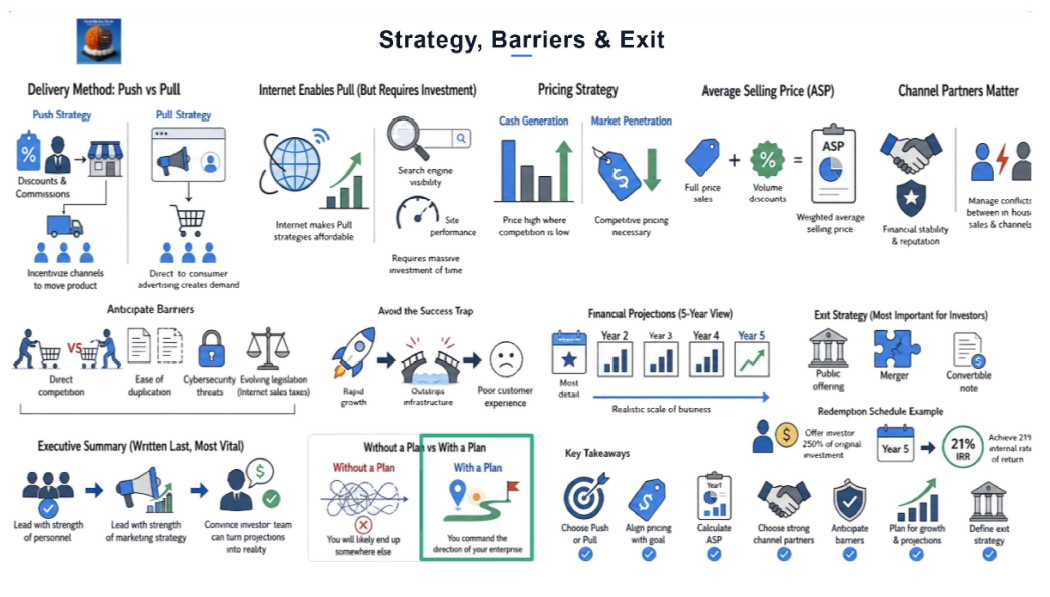
The delivery method of a business requires a choice between two primary strategies: Push and Pull. A Push strategy uses discounts and commissions to incentivize distribution channels to move the product into the market. Conversely, a Pull strategy focuses on direct-to-consumer advertising to create a demand that forces channels to carry the offering. While the Internet allows smaller firms to pursue Pull strategies more affordably, it requires a massive investment of time in search engine visibility and site performance. This strategy ties directly into pricing. If the goal is cash generation, you might price high where competition is low. If the goal is market penetration, competitive pricing is necessary. It is critical to calculate the Average Selling Price, or ASP, which accounts for the mix of full-price sales and volume discounts. If you rely on third-party channels, their financial stability and reputation become an extension of your own brand, and any conflict between in-house sales and these channels must be managed proactively. Success is often determined by how a founder anticipates barriers. These include direct competition, the ease with which a solution can be duplicated, and technical hurdles like cybersecurity or evolving legislation regarding Internet sales taxes. The C-Suite must also plan for the "success trap," where rapid growth outstrips the company's infrastructure, leading to a poor customer experience. Financial projections should provide a realistic scale of the business over five years, though the first year requires the most detail. For investors, the "exit strategy" is the most important consideration. This could be a public offering, a merger, or a convertible note where a loan converts into equity. Specific redemption schedules can be utilized, such as offering an investor 250% of their original investment by year five to achieve a 21% internal rate of return. Ultimately, the Executive Summary, though written last, is the most vital part of the plan. It must be crisp, credible, and compelling—the document that will ultimately determine whether an investor gives you 30 minutes of their time.