A comprehensive guide to developing effective marketing strategies aligned with your business plan
Marketing Plans Relative to Business Plans Narrative
Marketing vs. Business Plan
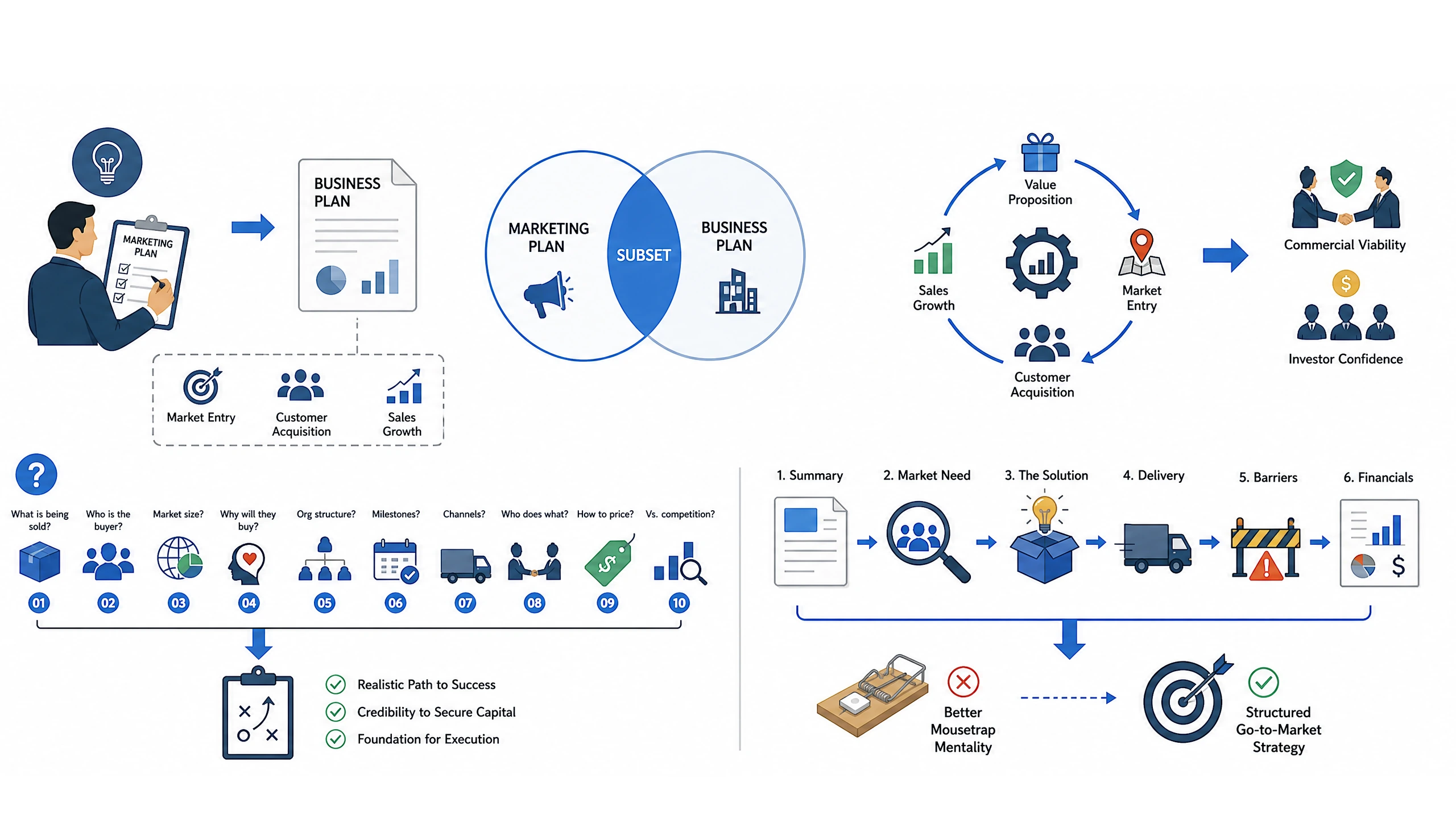
A marketing plan is not merely a promotional document; it is the strategic engine that drives a startup's commercial viability and secures the confidence of potential investors. For an entrepreneur, understanding the relationship between a marketing plan and a business plan is fundamental. As shown, a marketing plan serves as a limited form of a business plan, specifically designed to emphasize market entry, customer acquisition, and sales growth. While a business plan covers the entire organizational structure, the marketing plan drills down into the tactical execution of the company's value proposition. Startup leadership must treat this document as a framework for management to follow as they pursue specific revenue objectives.
The creation process begins by addressing a series of rigorous questions that determine whether a business has a realistic path to success. Leadership teams must define exactly what is being sold, the specific identity of the buyer, the total addressable market size, and the underlying motivation for the purchase. Furthermore, the plan must detail the structure of the marketing organization, the measurable milestones for success, and the specific distribution channels. If a management team cannot answer who will have what responsibility or how the offering will be priced against the competition, the plan will lack the credibility required to secure capital.
To maximize impact, the plan must be structured to maintain reader interest while providing high-density information. This involves a logical flow: summarizing the plan, demonstrating the market need, describing the solution, explaining the delivery method, acknowledging barriers, and providing financial projections. By following this sequence, a startup can prove it has moved beyond a "better mousetrap" mentality to a structured go-to-market strategy. In short, the marketing plan translates a business vision into a set of actionable, measurable sales and promotion steps.
Defining the Market Need
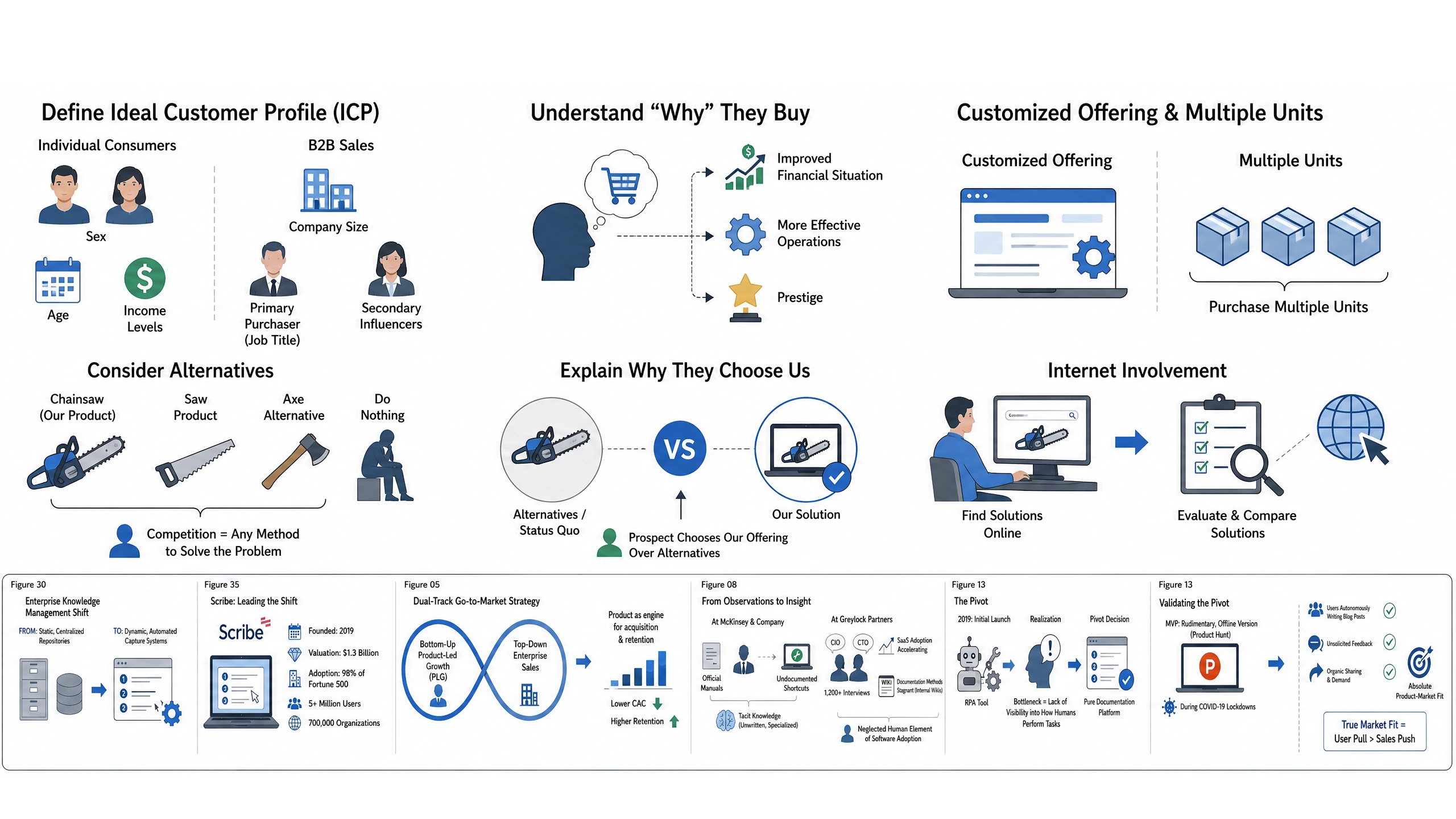
The "Show the Need" section is where a startup defines its Ideal Customer Profile, or ICP, and the market gap it intends to fill. Leadership must provide a granular description of the prospective buyer. This involves segmenting the market into individual consumers or business entities. For individual consumers, descriptions should include sex, age, and income levels. For B2B sales, the plan must identify the size of the target company, the job titles of the primary purchasers, and the secondary influencers who affect the final decision.
Understanding the "why" behind a purchase is equally critical. Leadership must explain the expected results in terms of improved financial situations or more effective day-to-day operations. For some segments, the motivation might even be "prestige." You must explain whether a prospect will require a customized offering or if they are likely to purchase multiple units.
An often-overlooked component of market need is the existence of alternatives. For example: if you are selling chainsaws, the customer's alternatives aren't just other chainsaws; they could be an axe, a tree saw, or even deciding to do nothing at all. This illustrates that competition is not just other companies, but any method the customer currently uses to solve their problem. A startup must explicitly document these alternatives and explain why the prospect would choose their specific offering over the status quo. If the Internet is involved, the plan must further describe how the prospect interacts with digital platforms to find and evaluate these solutions.
Detailing the Solution
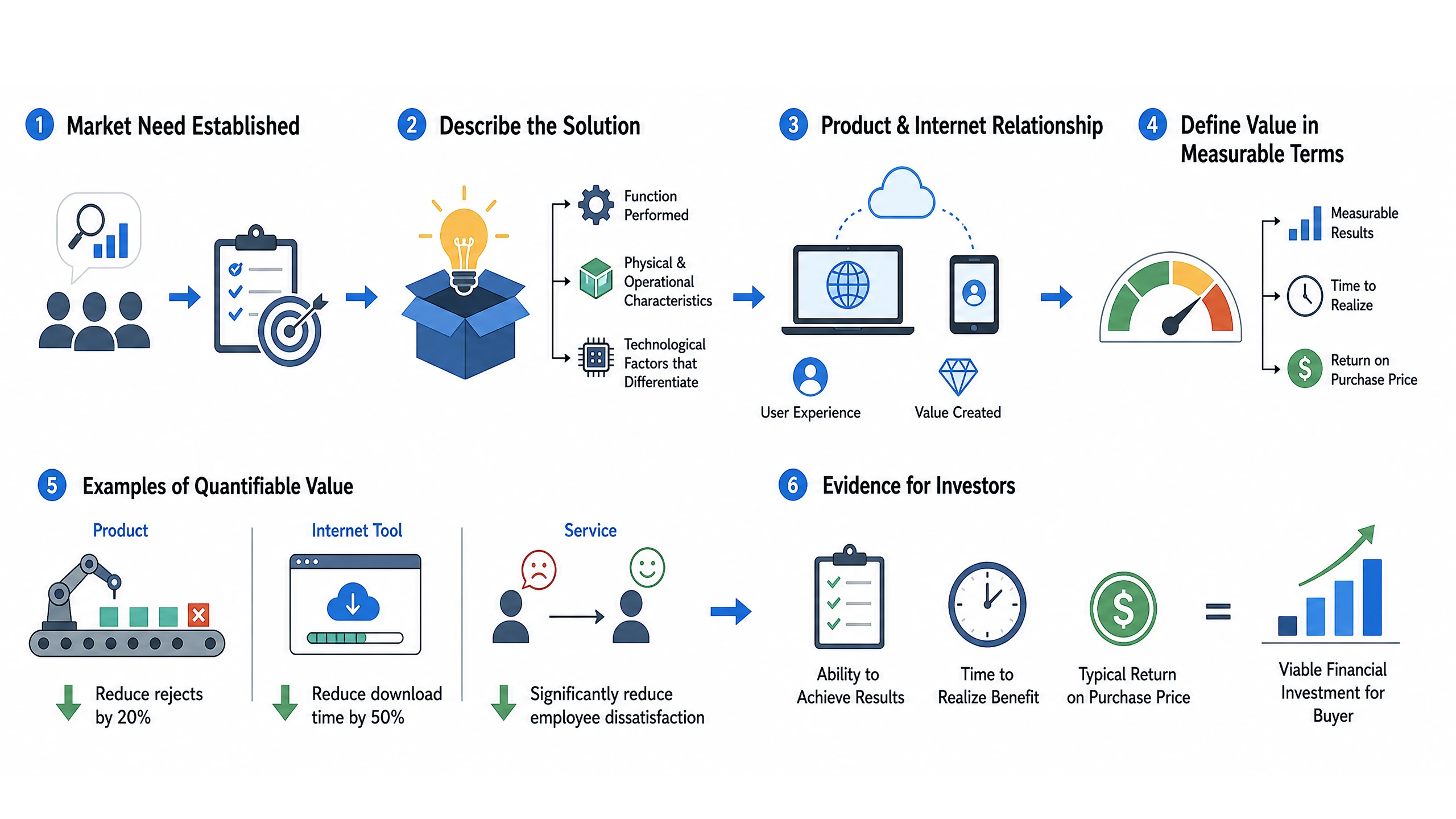
Once the market need is established, the plan must detail the solution. This section is often the easiest for founders to write because it focuses on the product or service they have built, but it must remain disciplined and objective. The description should cover the function performed, physical and operational characteristics, and the important technological factors that differentiate it. For a service-based startup, the plan focuses on the purpose, content, and unique delivery methods that make it more desirable than existing competitive services.
A critical modern consideration is the relationship between the product and the Internet. If the product is delivered or promoted online, the plan must explain the technical implications and how users interact with the platform. This is not just a technical spec; it is a description of the user experience and the value it creates. Startup leadership must define value in measurable terms to make a compelling business case.
A few examples of how to quantify value: a product might "reduce rejects by 20 percent," an Internet tool might "reduce download time by 50 percent," or a service might "significantly reduce employee dissatisfaction." General claims are insufficient for investors; the plan must address the ability to achieve these results, the time required to realize the benefit, and the typical return on the customer's purchase price. This measurable data provides the evidence that the startup's solution is a viable financial investment for the buyer.
Promotion and Pricing Strategy
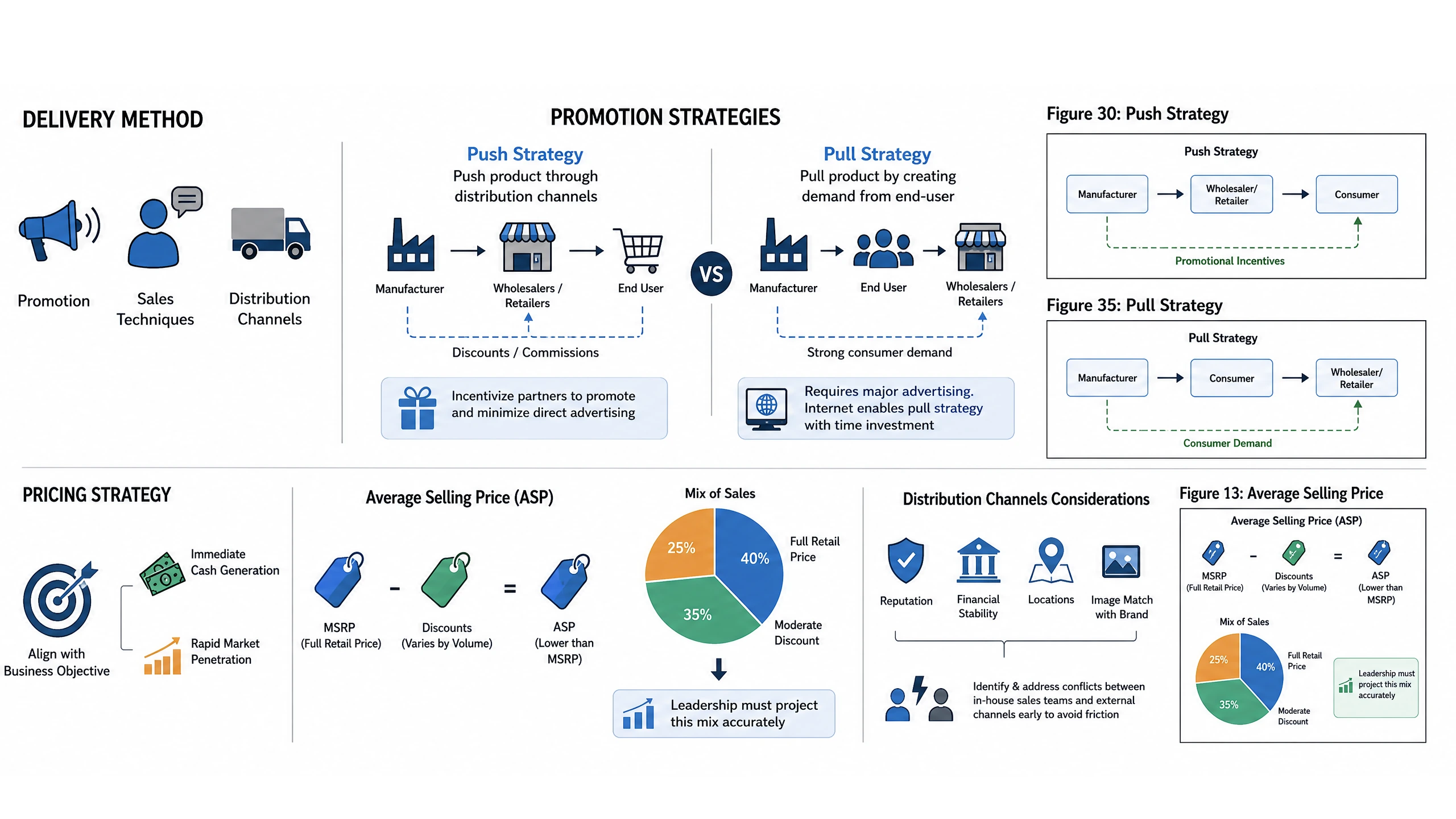
The delivery method encompasses promotion, sales techniques, and distribution channels. Startup leadership must choose between two basic promotion strategies: Push and Pull. The Push strategy maximizes the use of distribution channels—such as wholesalers or retailers—to "push" the product into the market. This often requires generous discounts or commissions to incentivize these partners to promote the offering, which can minimize the startup's need for direct advertising.
In contrast, the Pull strategy focuses on direct interface with the end-user. This requires a major commitment to advertising to create such strong consumer demand that channel outlets are forced to carry the product. Note that while the Internet allows even small businesses to pursue a Pull strategy without high dollar advertising costs, it requires a significant time investment to make a website "findable" among millions of competitors.
Finally, the pricing strategy must align with the overall business objective, whether that is immediate cash generation or rapid market penetration. The concept of Average Selling Price, or ASP, should be introduced for managerial purposes. Because of the mix of sales—ranging from full retail price to deep volume discounts—the resulting ASP will often be lower than the MSRP. Leadership must project this mix accurately. If the business depends on third-party channels, the plan must assess their reputation, financial stability, and whether their locations and image are consistent with the startup's brand. Conflicts between in-house sales teams and external channels must be identified and addressed early to avoid operational friction.
Risks, Financials, and Summary
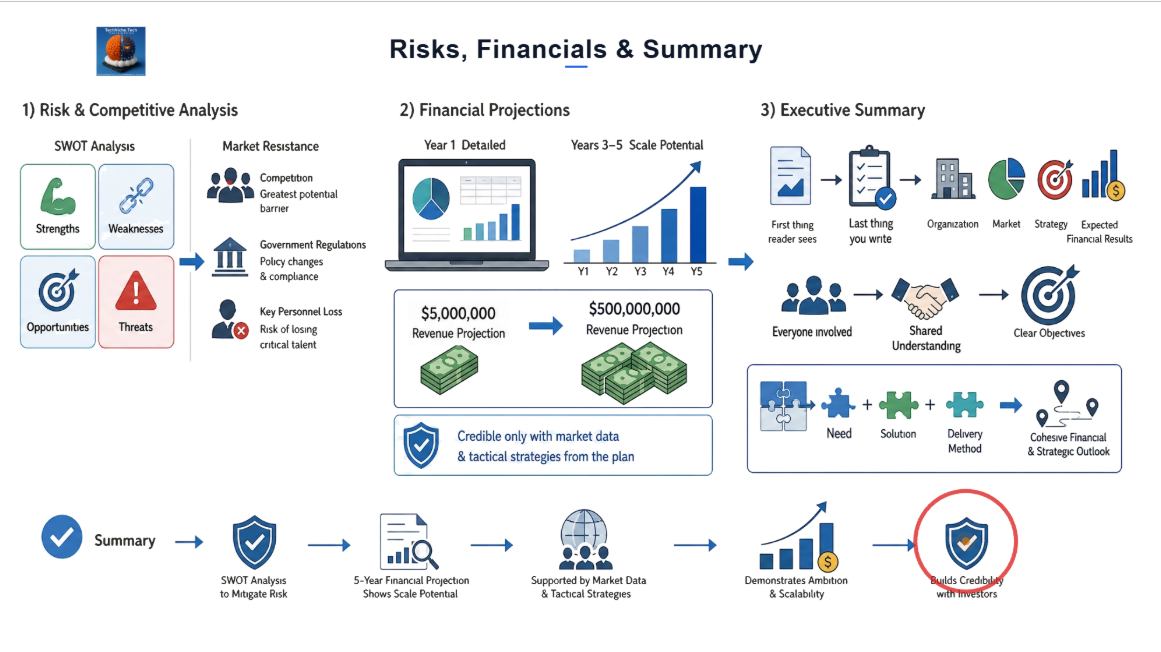
A realistic marketing plan does not ignore risks; it acknowledges them through a SWOT analysis and an assessment of market resistance. Competition is the greatest potential barrier to success. Startup leadership must describe the competitive aspects of their industry and provide detailed profiles of their strongest specific competitors. The SWOT analysis—Strengths, Weaknesses, Opportunities, and Threats—is where leadership describes how they will leverage internal strengths to seize opportunities and how they will compensate for known weaknesses. This includes addressing external threats like changes in the economy, new government regulations, or the loss of key personnel.
The final pillar of the plan is the financial projections. Emphasize that while projections for the first year should be detailed, the long-term objective for years three to five is to provide an understanding of the potential scale. Investors look at the difference between a five million dollar revenue projection and a five hundred million dollar projection to understand the ambition and scalability of the venture. These figures are only believable if they are supported by the preceding market data and tactical strategies outlined in the plan.
The final step in the process is writing the Executive Summary. Although it is the first thing a reader sees, it is the last thing you write. It should clearly and concisely present the highlights of the organization, the market, the strategy, and the expected financial results. A strong summary ensures that everyone involved in the effort has a clear, shared understanding of the objectives.
By synthesizing the need, the solution, and the delivery method into a cohesive financial and strategic outlook, the startup leadership can demonstrate a roadmap that is both ambitious and achievable. A marketing plan is a high-emphasis subset of a business plan that defines the tactical framework for sales, distribution, and market penetration.