


← Back to Business Plans Directory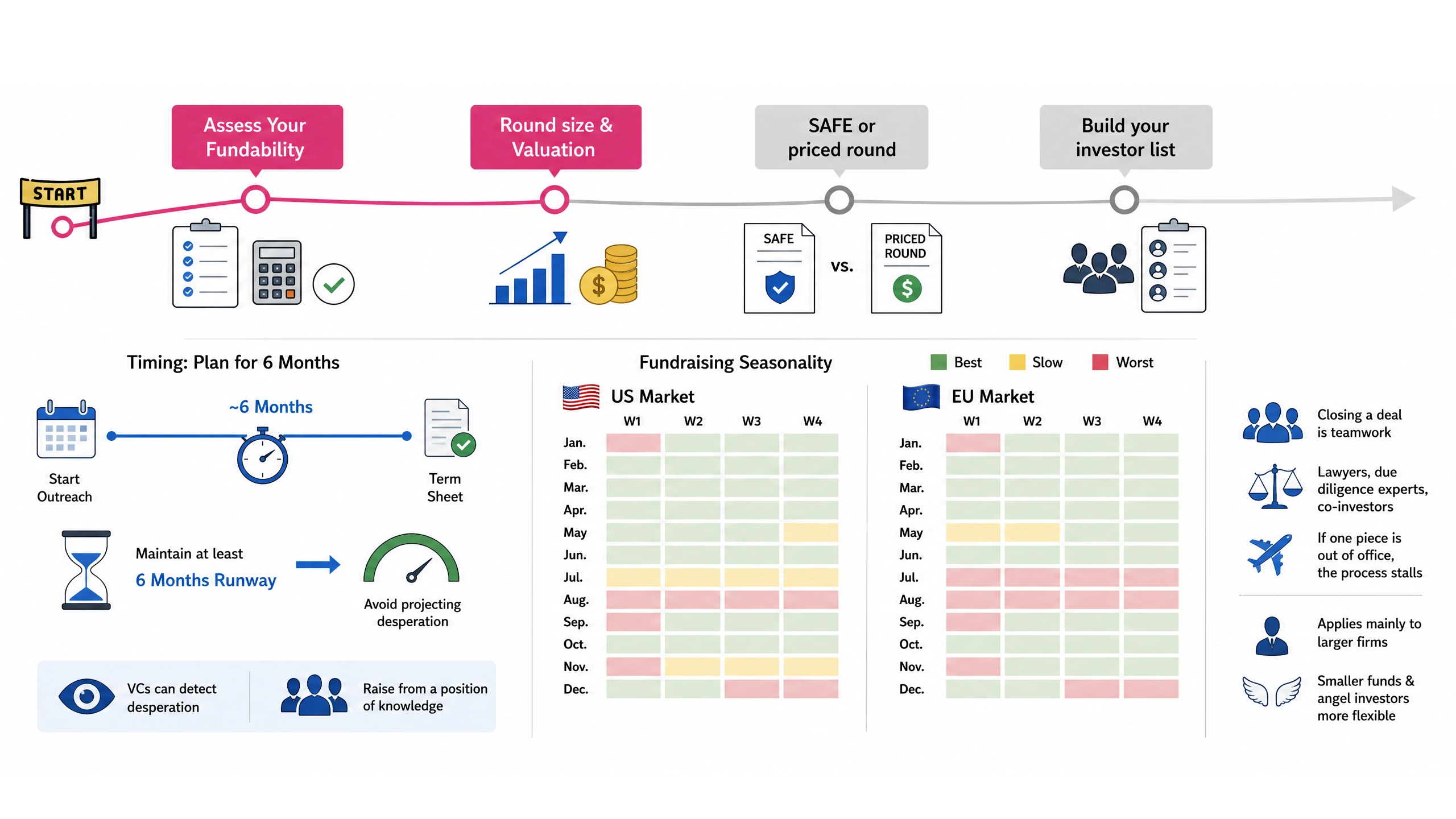
Winning Fundraising Strategy Narrative
Master wave-based investor outreach, tranche structuring, and strategic timing for successful fundraising
Winning Fundraising Strategy Narrative
Winning Fundraising Strategy - Preparation & Seasonality Journey
Fundraising for a startup is a process that cannot be entirely planned, yet failing to prepare is an invitation for wasted time and unnecessary stress. For a leadership team, the goal is to run a tight process that prioritizes momentum and access. Before reaching out to a single person, four foundational elements must be solidified. First is fundability. It is necessary to assess whether the company meets the criteria VCs look for, using tools like a fundability calculator. Second, the round size and valuation must be defined. Third, the choice between a SAFE or a priced round must be made, as this dictates the legal and financial framework of the deal. Finally, an initial investor list is required. Looking at Figure 2, this sequence is laid out as a linear progression: starting with assessment, moving through valuation and instrument choice, and concluding with the construction of an investor list. This preparation ensures that when the conversation begins, the leadership team is raising from a position of knowledge rather than guesswork.
Once prepared, timing becomes the critical variable. While some rounds close in weeks, the standard rule of thumb is to prepare for a six-month journey. This implies that a startup should maintain at least six months of runway to avoid projecting desperation, which VCs are trained to detect. Beyond the duration, seasonality plays a major role in when a term sheet actually gets signed. In the detailed breakdown of fundraising seasonality across the US and European markets, green indicates the best times to secure a term sheet, while red and yellow indicate significant slowdowns. Notice that July and August are essentially dead months due to summer holidays, as is the period from mid-December through early January. May is slowed by various holidays, and November is impacted by Thanksgiving in the US. This seasonality exists because closing a deal is teamwork involving lawyers, due diligence experts, and co-investors. If one piece of that chain is out of the office, the process stalls. However, this primarily applies to larger firms; smaller funds and angel investors are often more flexible and available during off-peak times. While relationships should be built year-round, execution should be timed to avoid these administrative dead zones.
Prioritization & Milestones
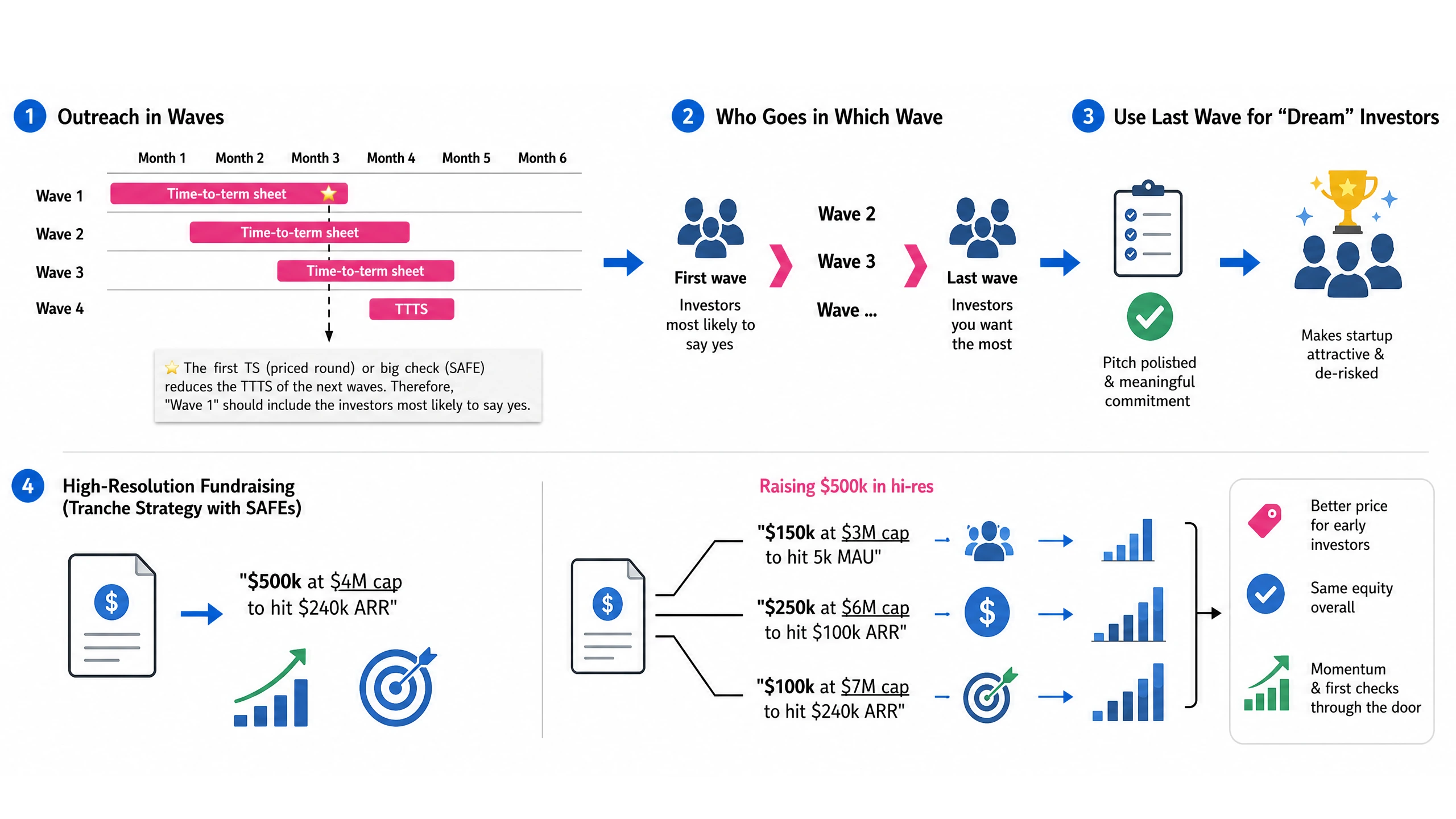
Strategic prioritization prevents the common mistake of activating an entire investor list simultaneously. Instead, founders should organize outreach into waves. The concept of "Time-to-Term Sheet" or TTTS across four distinct waves shows that securing the first term sheet or a significant check in Wave 1 drastically reduces the TTTS for subsequent waves. Consequently, Wave 1 must consist of the investors most likely to say "yes"—those with existing trust or a demonstrated love for the product. This creates the social proof necessary to accelerate the rest of the round. The last wave is reserved for "dream" investors—high-profile names like Sequoia or Andreessen Horowitz. By the time these firms are approached, the pitch will be polished and a significant portion of the round will already be committed, making the startup a much more attractive, "de-risked" investment.
To further enhance momentum, founders can utilize "high-resolution fundraising," a strategy particularly effective with SAFEs. Rather than raising a single lump sum at one fixed valuation, the round is sliced into smaller tranches with increasing caps tied to specific milestones. The "hi-res" approach breaks down a $500,000 raise into: first, $150,000 at a $3 million cap to hit a user milestone; then $250,000 at a $6 million cap for an interim revenue goal; and finally, $100,000 at a $7 million cap to hit the final target. This tiered structure provides a powerful "hook" for early investors, offering them a better price in exchange for being the first to commit. It does not cost the founders more equity overall, but it provides the necessary incentives to get the first checks through the door, which is often the hardest part of any raise.
Tactical Access & The Wheel
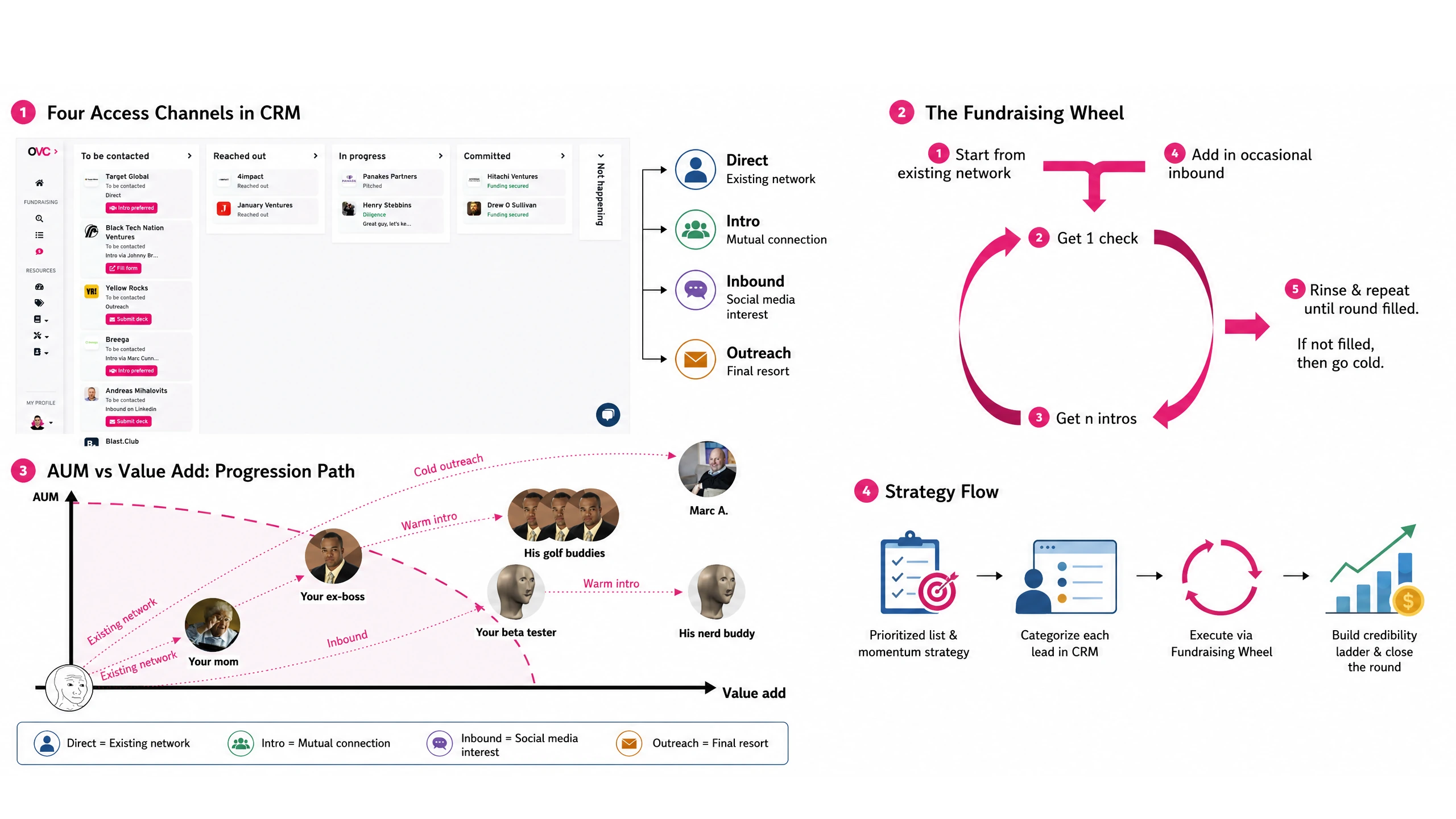
With a prioritized list and a momentum strategy in place, the focus shifts to the tactical access of each investor. There are four primary channels: Direct, Intro, Inbound, and Outreach. Every lead is categorized by the optimal approach. If an investor is in the existing network, they are labeled "Direct." If a mutual connection exists, "Intro" is the preferred path. For investors active on social media, "Inbound" strategies are used to draw them in, and for everyone else, "Outreach" is the final resort. This organization ensures that no contact is wasted and the highest-probability channels are exhausted first.
The execution of these tactics is governed by "The Fundraising Wheel," a framework that describes the self-reinforcing cycle of a successful raise. It begins at step one: starting with the existing network. Step two is getting that first check. Immediately following a commitment, step three is crucial: asking that investor for multiple introductions to their own network. Intros from an actual investor carry the highest credibility. Occasionally, as noted in step four, inbound interest will occur, which is fed back into the cycle. Step five is the "rinse and repeat" phase, where every check opens new doors. As the wheel spins, the startup builds a "ladder" of credibility, moving from friends and family to professional angels, and finally to major VCs.
The relationship between Asset Under Management (AUM) and the Value Add an investor provides shows your existing network at the origin, while as you move along the axes toward high-profile figures like tier-one VCs, the path transitions from "Existing network" to "Warm intro" and eventually "Cold outreach." The strategy is to fill as much of the round as possible through the wheel before going cold. This allows you to open cold emails with the high-leverage statement that the round is already "50% committed." By following this structured process—from preparation and seasonality planning to prioritization waves and the fundraising wheel—a leadership team can transform a chaotic search for capital into a rigorous, winning strategy.