


← Back to Business Plans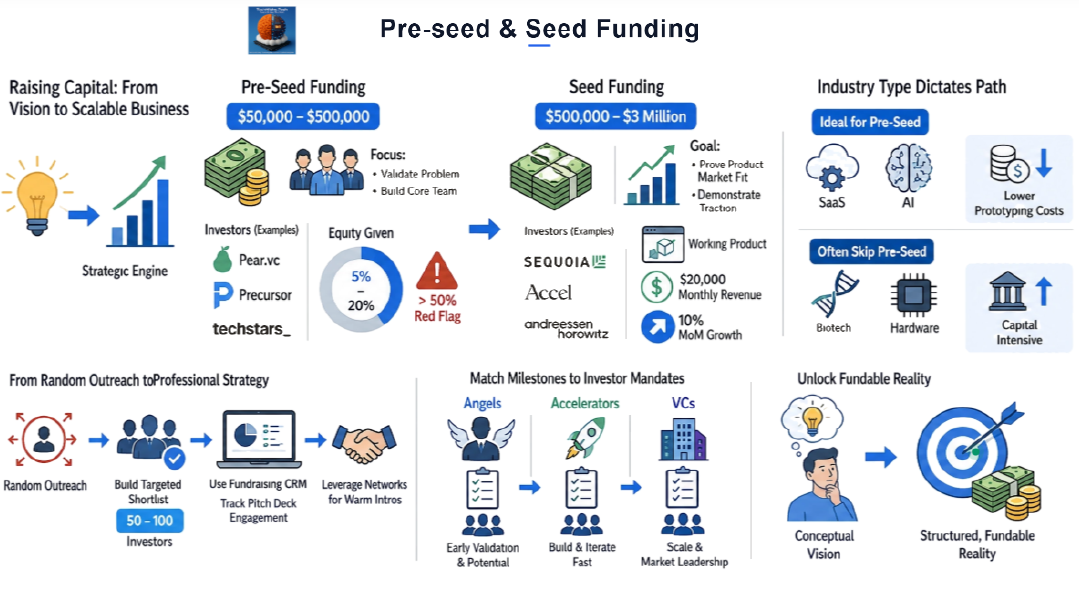
Pre-Seed & Seed Funding Narrative
Understanding the earliest stages of startup financing, funding structures, and top venture capital firms
Pre-Seed & Seed Funding Narrative
Pre-seed & Seed Funding
Raising capital is the strategic engine that moves a startup from a raw vision to a scalable business.
Understanding the distinction between pre-seed and seed funding is critical for managing your company's
capitalization effectively. Pre-seed investing, typically ranging from $50,000 to $500,000, is the earliest stage
where investors—such as Pear.vc, Precursor, or Techstars—bet on the founder's unique insight and a tangible
MVP. At this level, the focus is on validating the problem and building a core team. Founders should expect to
trade between 5% and 20% equity; reaching for more than 50% is a significant red flag for future growth.
Transitioning to seed funding—which ranges from $500,000 to $3 million—requires demonstrated traction.
While pre-seed is about getting off the ground, seed funding is designed to prove product-market fit. Investors
like Sequoia, Accel, or Andreessen Horowitz generally look for a working product and early revenue, often
targeting $20,000 in monthly revenue with 10% month-over-month growth. Industry type dictates the path:
SaaS and AI are prime for pre-seed rounds due to lower prototyping costs, while capital-intensive sectors like
biotech or hardware often bypass pre-seed for larger institutional rounds. To secure this capital, entrepreneurs
must move beyond random outreach. A professional strategy involves building a targeted shortlist of 50 to 100
aligned investors, utilizing a fundraising CRM to track pitch deck engagement, and leveraging networks for
warm intros. By matching your startup's milestones to the specific mandates of angels, accelerators, or VCs,
you transform a conceptual vision into a structured, fundable reality.