

← Back to Business Plans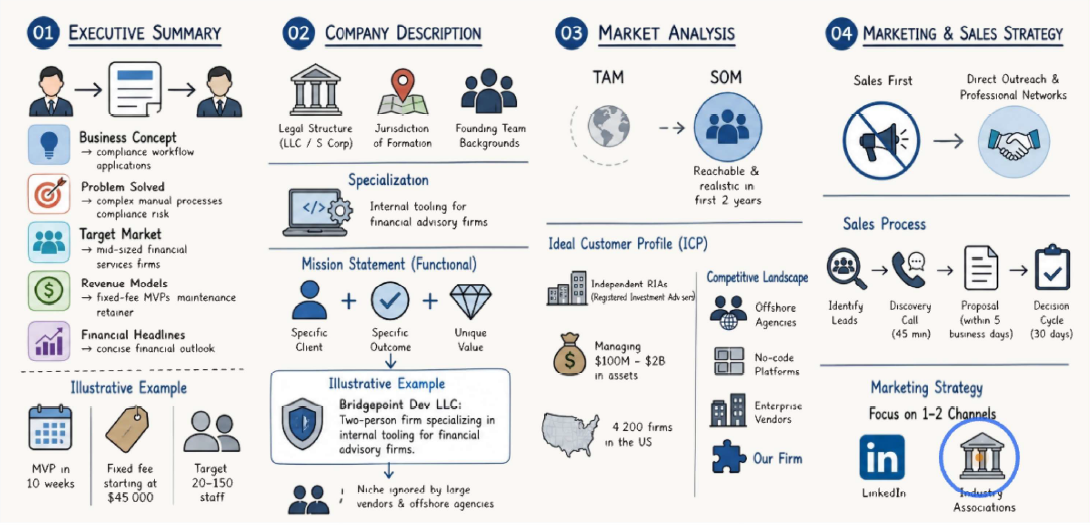
AppDev BPlan-2 Narrative
Foundation, strategy, operations, and financial planning for sustainable software business
AppDev BPlan-2 Narrative
AppDev Business Plan 2
Foundation and Strategy
The difference between a sustainable software business and a failing freelance project often lies in your ability to communicate value to decision-makers. The Executive Summary serves as that critical first point of contact for an investor or partner. While it appears first, you actually write it last so it accurately reflects your entire business plan. It condenses your business concept, the specific problem you are solving, your target market, and your revenue models into just a page or two. Credibility here is earned through specificity. As the illustrative example shows, saying you build compliance workflows for mid-sized financial services is much better than just claiming to build "custom software." You outline a clear target—like firms with 20 to 150 staff—and state exactly what you deliver: MVPs in 10 weeks for a fixed fee starting at $45,000. This detail lets the reader immediately grasp the scale of your operation.
Next, the Company Description establishes your formal identity. This covers your legal structure, jurisdiction, and team background. But more importantly, it includes your mission statement. A highly functional mission statement avoids generic fluff; it explicitly defines the specific client, the specific outcome, and the unique value you provide. Take Bridgepoint Dev LLC for instance. They are a two-person firm specializing in internal tooling for financial advisory firms—a niche specifically chosen because it's ignored by large enterprise vendors and offshore agencies. This positions them as specialists, not generalists.
Moving to Market Analysis, you need to prove there is an accessible market for your services. For small teams, the massive Total Addressable Market doesn't matter as much as the Serviceable Obtainable Market, which is the number of clients you can realistically reach and close within your first two years. This requires defining an Ideal Customer Profile, or ICP. For example, your target might be independent RIAs managing between 100 million and 2 billion dollars in assets. By identifying that approximately 4,200 firms meet this exact profile, you calculate a realistic revenue ceiling. You also must acknowledge your competitive landscape, comparing yourself against offshore teams, no-code tools, and enterprise vendors.
Finally, we look at your Marketing and Sales Strategy. Early on, sales takes precedence over marketing. Initial growth is driven by direct outreach and professional networks, rather than broad ad campaigns. You map out the exact journey from first contact to a signed contract. The sales process defines how you identify leads, structure a 45-minute discovery call, deliver a proposal within five business days, and aim for a 30-day decision cycle. Any marketing efforts should be highly restricted to just one or two channels—like LinkedIn or industry associations—so you don't overextend your resources. The single key takeaway here is that specificity breeds credibility; a tightly defined niche and a highly structured sales process make your business plan immediately viable to any reader.
Operations and Financials
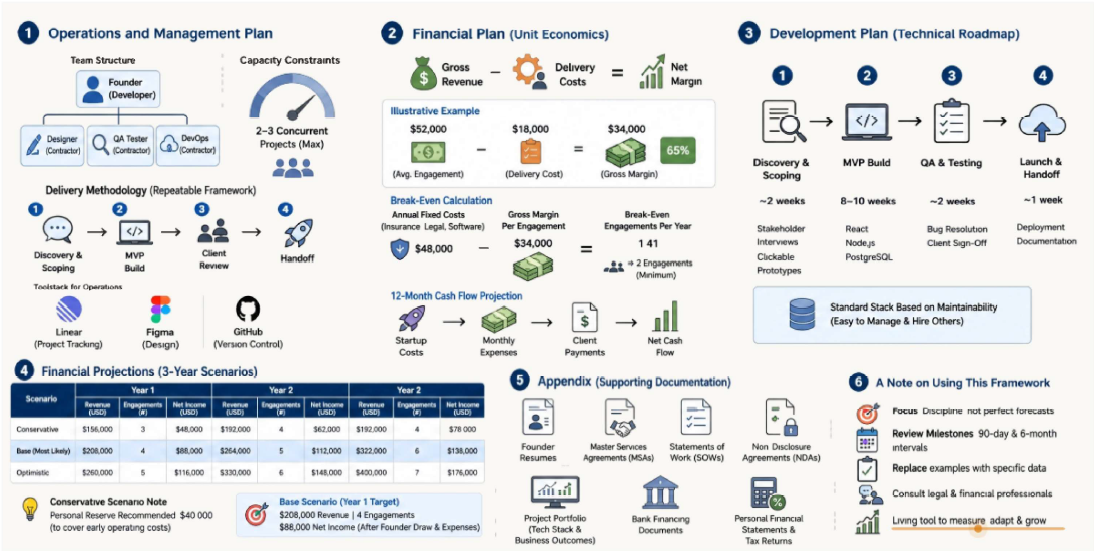
To execute on this solid strategic foundation, the next step is to detail your Operations and Management Plan, mapping out exactly how your team will deliver these projects day-to-day. This section details your team structure and, crucially for independent developers, you must honestly document your capacity constraints. It's all about knowing exactly how many concurrent projects you can handle without sacrificing quality. To maintain that quality, you need a repeatable delivery methodology. Our illustrative framework breaks this down into four clear phases: Discovery, MVP Build, Client Review, and finally, Handoff. We also firmly define the operational toolstack, using Linear for tracking, Figma for design, and GitHub for version control. Establishing these standards ensures consistent delivery and mitigates key-person risks.
Moving to the Financial Plan, we focus first on Unit Economics. Before you project years into the future, you have to understand the profitability of just one single project. The logic is a simple subtraction: Gross Revenue minus Delivery Costs equals your Net Margin. If an average engagement brings in 52,000 dollars, and your delivery costs—like subcontractor hours and software—are 18,000 dollars, that yields a gross margin of 34,000 dollars, or 65 percent. To figure out your break-even point, you simply divide your annual fixed costs by this per-project margin. Here, 48,000 in fixed costs divided by our 34,000 margin means we need to complete at least two engagements per year just to survive. That baseline feeds directly into our 12-month cash flow projection.
The Development Plan acts as your technical roadmap. This proves to non-technical stakeholders that you have a structured process. It mirrors the operations flow with four specific technical phases. You move from a two-week Discovery phase into an 8 to 10 week MVP build, followed by QA testing, and finally Launch and Handoff. Notice we emphasize using a standard stack based on maintainability. Building in well-supported tech like React and Node builds long-term trust because the client knows they can easily hire others to manage it later.
We expand unit economics into three-year Financial Projections. Rather than guessing one future, we plan across three scenarios: conservative, base, and optimistic. Your Base Scenario is your target—here, four engagements yielding 88,000 dollars in net income. However, your Conservative Scenario prepares you for reality. If things start slow and you only land three projects, you'll need a personal reserve of around 40,000 dollars to cover those early operating costs. This is why we model different outcomes.
To keep the main document readable, everything else goes into the Appendix. This is your proof. It's where you store resumes, sample MSAs, statements of work, and NDAs. If you are seeking bank financing, your personal tax returns and project portfolios live here too. Ultimately, the true value of this framework isn't in predicting the future perfectly, it's about the discipline of the planning process. It gives you a rigid baseline for reviewing milestones every 90 days. By putting in specific numbers and consulting professionals, you are building a living tool to measure, adapt, and grow your software business.