Complete framework for launching a startup with strategy and execution
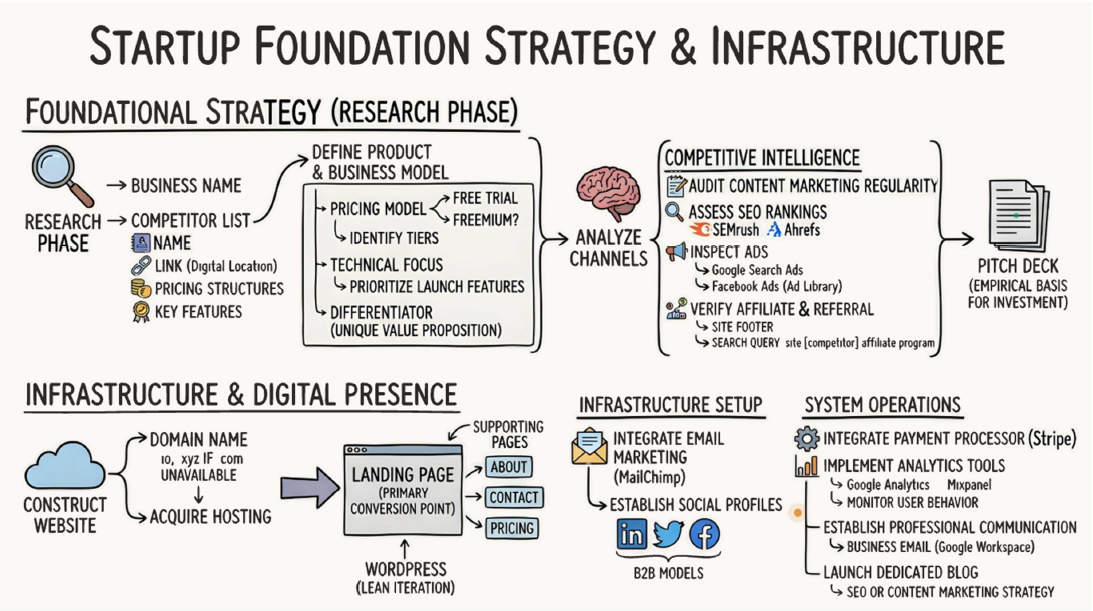
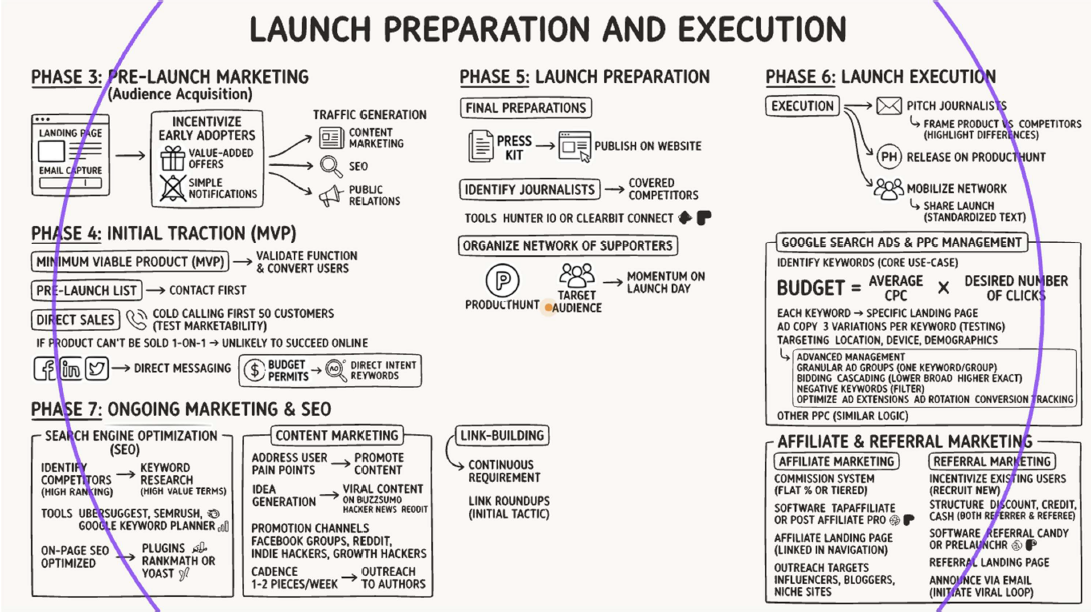
StartUP Launch Checklist Preparation & Pre-Launch Phase This section outlines the critical groundwork you need to lay before executing a startup launch. We divide this into two main halves. Let's start up here with the Foundational Strategy, which takes place during your initial Research Phase. The process begins right here with dictating your overall product and marketing strategy. Your very first requirements are to select a solid business name and to start systematically compiling a detailed competitor list. You shouldn't just list names; you need their digital location, their pricing structures, and an honest breakdown of their key features. Once you know who you are up against, you need to firmly define your own product and business model. This involves several critical choices. You have to decide on a pricing model—for instance, will you offer a free trial, or perhaps a freemium tier? You also need to identify your specific tiers of service. At this stage, your technical focus should be strictly on identifying which features to prioritize for your initial launch. Most importantly, you need to establish your differentiator—the unique value proposition that truly separates your product from the existing market solutions you just researched. Next, you need to analyze the existing marketing channels to gather competitive intelligence. You do this by auditing how regularly your competitors publish content, assessing their SEO rankings using tools like SEMrush or Ahrefs, and inspecting their ad strategies via Google Search Ads or the Facebook Ad Library. You should also verify if they have affiliate and referral programs by checking their site footers or running specific search queries. If you are seeking external investment, all of this accumulated data forms the empirical basis for your pitch deck right here. Once the strategy is set, we move to the second step: Infrastructure and Digital Presence. This starts when you construct your website, which acts as the physical and digital foundation for all your subsequent marketing. First, you need to secure a domain name—prioritizing dot io or dot xyz extensions if the dot com is unavailable—and acquire hosting. Your main focus here is the Landing Page. This is your primary conversion point. Many startups utilize WordPress here because it allows for very lean, rapid iteration. Alongside this, you must develop your supporting pages, like About, Contact, and Pricing, to provide a complete and trustworthy user experience. Simultaneously, you need to handle your infrastructure setup. This means integrating an email marketing provider, such as MailChimp, and establishing social profiles on platforms relevant to your audience—typically LinkedIn, Twitter, and Facebook for B2B models. Finally, you must configure your System Operations. This requires integrating a payment processor like Stripe so you can actually get paid, and implementing analytics tools like Google Analytics or Mixpanel so you can monitor exactly how users behave on your site. You also need to establish a professional communication layer via a business email service like Google Workspace. And, if your strategy heavily involves SEO, launching a dedicated blog is an absolute must. Launch & Growth Execution Now let's move into the third phase, Pre-Launch Marketing. The main goal here is audience acquisition before you officially release your product. To do this, you want to set up an email capture mechanism on your landing page. But just asking for an email isn't enough. You need to incentivize your early adopters. Offer them something of value, like a special discount or exclusive content, rather than just sending simple notifications. To get people to that page, your traffic generation strategy should rely heavily on content marketing, SEO, and public relations. Moving on to Phase four, Initial Traction. This is where you test your Minimum Viable Product, or MVP. The objective is simple: validate that the product actually functions as intended and that users will convert. Remember that pre-launch list you just built? Those are the very first people you contact. A huge part of this phase is direct sales. You should try cold calling your first 50 customers. Why? Because it serves as a raw test of the product's true marketability. If you can't sell your product in a one-on-one interaction, it is highly unlikely it will succeed automatically online. You can also source leads through social media platforms like Facebook, LinkedIn, and Twitter, reaching out via direct messaging. Next is Phase five: Launch Preparation. This is where you finalize all your marketing materials and prepare your network of supporters. Finally, Phase six is Launch Execution, where you coordinate your go-to-market strategy across all channels simultaneously. And Phase seven, Ongoing Marketing & SEO, is where you establish your long-term growth through content, link-building, and continuous optimization to maintain momentum after launch.