


← Back to Business Plans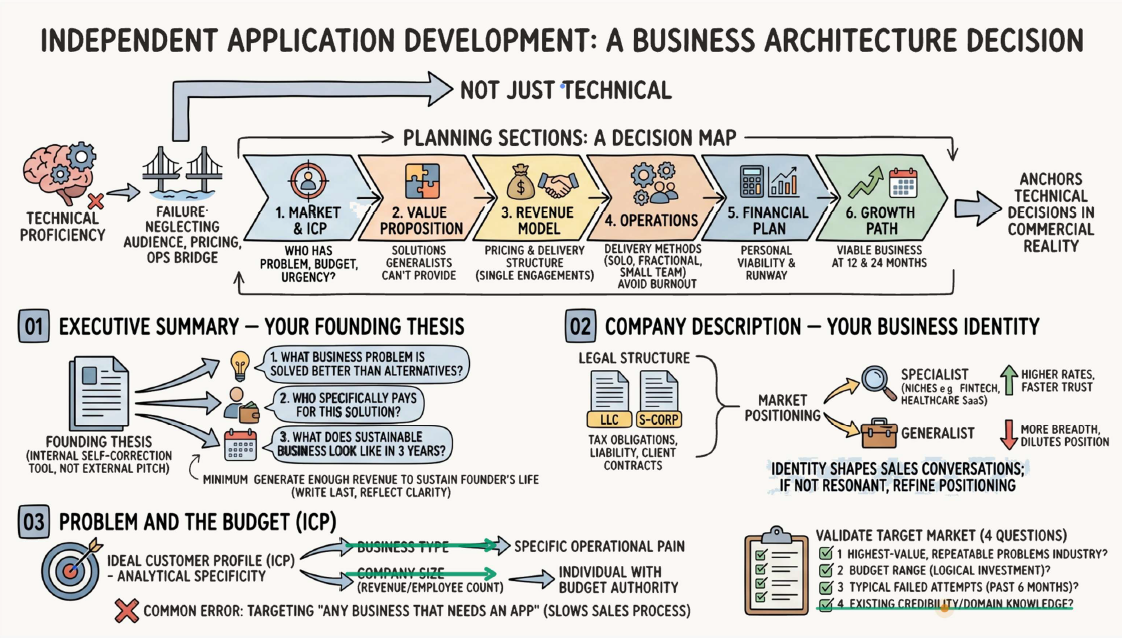
AppDev Business Plan Narrative
A comprehensive business planning framework for independent software developers and application architects
Application Software Business Plan
Business Architecture & Identity
Stepping into independent software application development is fundamentally a business architecture decision, not just a technical one.
We often think that writing great code is enough, but as you can see up here, it is not just technical.
In fact, relying solely on technical proficiency can lead you straight into a wall. Why do engineers fail when going solo? It is usually because of this broken bridge—they neglect to define their audience, their pricing strategies, and their operational bridge between projects.
To prevent this, we use a decision map built out of six core planning sections. Let's walk through this sequence.
First, you have your Market and Ideal Customer Profile. Who actually has the problem, the budget, and the urgency?
Second is your Value Proposition - what unique solutions can you offer that generalist agencies simply cannot?
Third is the Revenue Model. How will you structure and price these single engagements?
Fourth, we look at Operations. Are you delivering solo, as a fractional CTO, or with a small team? You have to design this to avoid burnout.
Fifth is your Financial Plan, where you calculate your personal runway.
And sixth, your Growth Path, mapping out what a viable business actually looks like at the 12 - 24 & 36 month marks.
This entire flow ensures that every technical decision you make is firmly anchored in commercial reality.
Now, let's look at the foundational pieces in detail. Down here in section one, we have the Executive Summary, which serves as your Founding Thesis.
Look at this document icon. This is not an external pitch deck for investors. It is strictly an internal self-correction tool.
A successful thesis must clearly answer three questions:
What specific business problem do you solve better than the alternatives?
Who, exactly, pays for this solution?
And what does a sustainable version of this business look like in three years?
Here is a vital rule for your thesis: the absolute minimum version of your business must generate enough revenue to sustain the founder's life.
You should actually write this section last, so it reflects the clarity you gain from completing the rest of the map.
Moving over to section two, you need to define your Company Description and Business Identity.
This comes down to two main components.
First is your Legal Structure. You need to choose between an LLC or an S-Corp. This choice directly dictates your tax obligations, legal liability exposure and financial loss vulnerability, and how you draft client contracts.
The second component is your Market Positioning. You have a major decision here.
Are you going to be a Specialist—targeting distinct niches like fintech or healthcare SaaS?
Specialization is highly advantageous because it commands higher rates and builds trust faster.
Or, will you be a Generalist? This gives you more breadth, but it almost always dilutes your market position.
Remember, your identity completely shapes your sales conversations. If prospects don't immediately resonate with your positioning, you need to refine it.
Finally, let's examine section three: The Problem and the Budget, which defines your Ideal Customer Profile.
You cannot rely on marketing generalities to succeed here; you need analytical specificity.
A sharp profile defines the exact business type connecting to their specific operational pain. It also defines the company size and identifies the exact individual who holds budget authority.
A very common, devastating error for independent developers and agency professionals is targeting "any business that needs an app" - Doing that will dramatically slow down your sales process.
To ensure you are on the right track, use this checklist on the right to validate your target market with four vital questions.
1. Does this industry produce high-value, repeatable problems?
2. Does their budget range make custom development a logical investment?
3. What have they typically tried and failed at over the past 6 months before calling you?
4. Do you have existing credibility or domain knowledge in this space?
Once you have these foundational elements nailed down, the total addressable market becomes less important than your specific serviceable market, which involves estimating exactly how many clients fit this precise profile we just built.
Economics & Operational Delivery
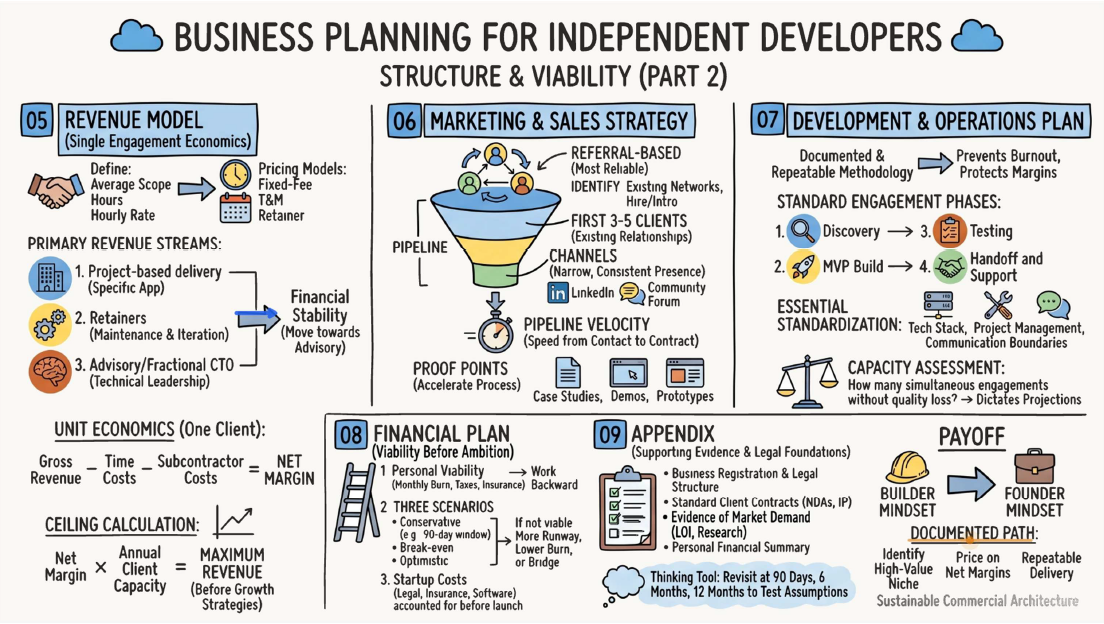
Let's dive into the economics of your solo practice, starting here on the top left with your Revenue Model.
Before projecting long-term growth, you absolutely must model the economics of a single client engagement.
This means defining the average project scope, the hours required, and your effective hourly rate. You will also need to align your Pricing Models with the nature of the work - whether that's fixed-fee, time-and-materials, or a retainer based relationship.
As an independent developer, there are three primary revenue streams.
First is project-based delivery, where you build a specific application.
Second are retainers for ongoing maintenance and iteration.
And third, advisory or fractional CTO roles, providing high-level technical leadership.
Notice this transition: true Financial stability is found by intentionally moving from project-based work toward these advisory services.
Now, how do we calculate the ceiling of your business?
Look at the Unit Economics for a single client.
Take your projected Gross Revenue and subtract the estimated Time Costs and Subcontractor Costs which will then result in your Net Margin.
If you multiply that Net Margin by your Annual Client Capacity, you get your Maximum Revenue possible before you need to introduce external growth strategies.
Moving to the center column, let's look at your Marketing & Sales Strategy.
For early-stage independents, the most reliable pipeline is referral-based. Identify people in your existing networks who can either hire you or provide warm introductions.
In fact, most successful independents secure their first 3 to 5 clients entirely through these existing relationships.
Beyond referrals, focus on one or two specific channels where your ideal client profile is active, like LinkedIn or specific founder communities.
A narrow, consistent presence feeding into your pipeline is far more effective than a broad, scattered approach. You will measure your success here by your Pipeline Velocity & how quickly a lead moves from initial contact to a signed contract.
You can accelerate this process by having solid Proof Points ready to go, such as case studies, demos, or prototypes.
Over on the top right, we establish the Development & Operations Plan.
To prevent heroic efforts that lead to burnout and protect your profit margins, your methodology absolutely must be documented and repeatable.
This means defining standard engagement phases: starting with Discovery, moving to the MVP Build, transitioning into Testing, and finally Handoff and Support.
You also need Essential Standardization for your tech stack, project management tools, and communication boundaries.
And crucially, perform an honest Capacity Assessment: how many simultaneous engagements can you sustain without a loss in quality?
This capacity dictates all your downstream financial projections.
Speaking of finances, look down at the center-left for the Financial Plan. It all starts with your Personal Viability.
You must determine your monthly personal burn rate, including taxes and insurance, and work backward.
You should map out three scenarios: conservative, break-even, and optimistic.
The conservative scenario should assume a 90-day window just to close the first client. If the business is not viable under these assumptions, you will need more runway, a lower burn rate, or a bridge.
Always account for your Startup Costs before launching. Moving to the right, the Appendix contains the operational and legal documents that validate this entire plan.
It serves as a personal checklist that includes business registration, standard client contracts, evidence of market demand, and your personal financial summary.
Ultimately, this business plan is your dynamic Thinking Tool, and meant to be revisited at 90 days, 6 months, and 12 months to test whether your initial assumptions were accurate.
Finally, the Payoff. Completing this framework shifts you from a Builder Mindset squarely into the Founder Mentality.
You now have a Documented Path to identify a high-value niche, price your expertise based on net margins rather than just hours, and maintain repeatable delivery, ensuring your technical skills are supported by a sustainable commercial architecture.