Explore strategies for growing your business through partnerships, sales excellence, and strategic expansion.
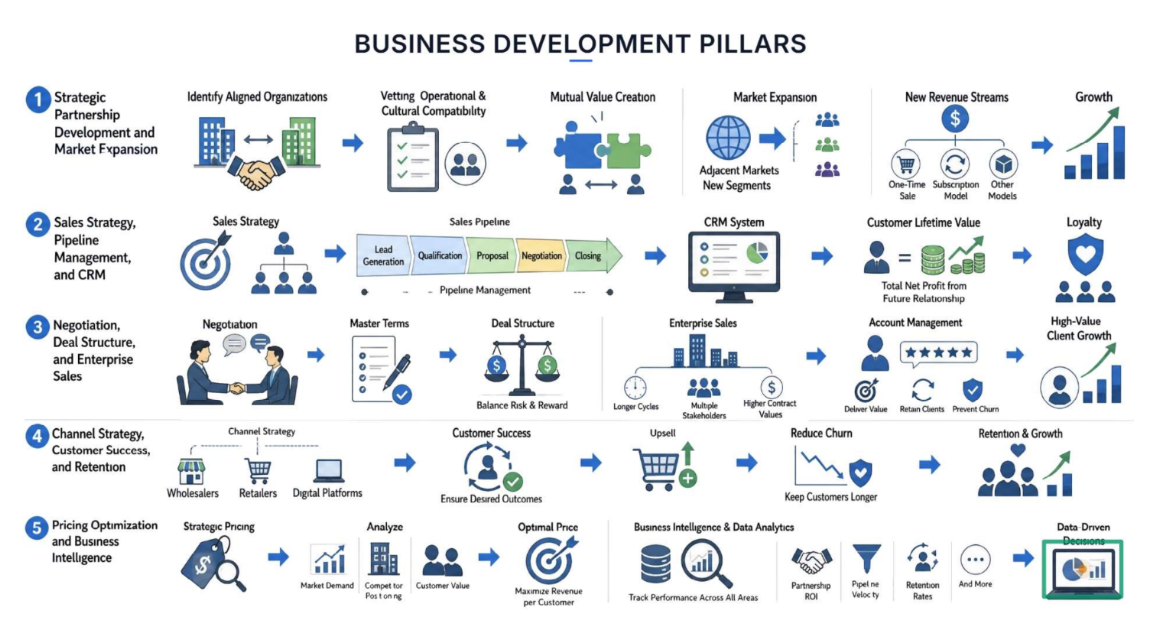
Business Development Pillars Sustainable business growth relies on more than just a quality product; it demands a structured approach to value creation through partnerships, sales excellence, and strategic expansion. Business Development is the set of strategies used to grow an organization through three primary levers: partnerships, sales excellence, and strategic expansion. This involves finding new customers, maximizing the value of existing relationships, and entering new markets. Strategic Partnership Development: This involves the systematic process of identifying, vetting, and negotiating alliances. This process begins by finding organizations whose goals align with the company's own. Following this is a vetting stage to ensure operational and cultural compatibility. These alliances are designed to create mutual value that neither party could achieve independently. Market Expansion and New Revenue Streams: Growth is achieved by leveraging external alliances and identifying new customer segments or business models, leading to overall growth. This includes exploring adjacent markets—sectors related to the current market but serving different needs or customer segments. Diversifying business models, such as moving from a one-time sale to a subscription-based model, is a key method for capturing these new revenue streams. Sales Strategy and Pipeline Management: We focus on building a structured organization capable of repeatable customer acquisition. A pipeline is the visual representation of the sales process, flowing from initial lead generation, through qualification, proposal, and negotiation, to the final closing of a deal. Managing this pipeline effectively ensures the sales team focuses on the most promising opportunities. Customer Relationship Management: Systems nurture and track customer interactions. The primary objective is to maximize Customer Lifetime Value, defined as the total net profit attributed to the entire future relationship. By tracking touchpoints, you build long-term loyalty. A managed sales pipeline acquires customers, while a Customer Relationship Management system ensures those customers remain profitable over time. Negotiation and Deal Structure: These are the technical skills required to finalize contracts. This involves mastering master terms and designing deal structures that balance risk and reward for both parties, ensuring sustainable cooperation. Complex growth requires specialized negotiation and dedicated management for large-scale corporate accounts. Enterprise Sales and Account Management: These sales often involve longer cycles, multiple stakeholders, and higher contract values. After the sale, account management focuses on retaining these high-value clients and preventing churn, driving high-value client growth. Channel Strategy and Distribution: Channel strategy expands market reach through third parties like wholesalers, retailers, and digital platforms. Utilizing distribution channels increases market reach, while customer success initiatives protect and grow existing revenue. Customer Success and Retention: Customer Success is a proactive strategy to ensure clients achieve desired outcomes. This leads to upselling and a reduction in churn, ultimately supporting retention and growth. Strategic Pricing and Revenue Optimization: Strategic pricing involves determining ideal price points by analyzing market demand and competitor positioning to find the optimal price that maximizes revenue per customer. Business Intelligence and Data Analytics: Business Intelligence and Data Analytics serve as the foundation for all business development decisions. Analytics track performance across all areas—from partnership Return on Investment to pipeline velocity and retention rates, enabling data-driven decisions. Data provides the evidence needed to optimize pricing and refine every stage of the business development lifecycle. Integrating Business Development Disciplines: By integrating these disciplines—partnerships, sales strategy, negotiation, and data analytics—an organization transforms into a proactive driver of its own growth. You now have the framework to build a scalable ecosystem that sustains long-term revenue and market relevance.
Identifying, vetting, and negotiating strategic partnerships and alliances.
Exploring adjacent markets and diversifying business models for growth.
Building effective sales organizations and managing customer acquisition.
Implementing systems to nurture, track, and maximize customer lifetime value.
Mastering contract negotiations, terms, and deal structures that benefit both parties.
Developing strategies for large-scale client acquisition and retention.
Building and managing distribution channels to expand market reach.
Maximizing customer satisfaction, upselling, and reducing churn.
Determining optimal pricing models and maximizing revenue per customer.
Leveraging data to inform business development decisions and strategies.