Explore strategies for embedding accountability into every layer of your startup and the benefits of doing so.
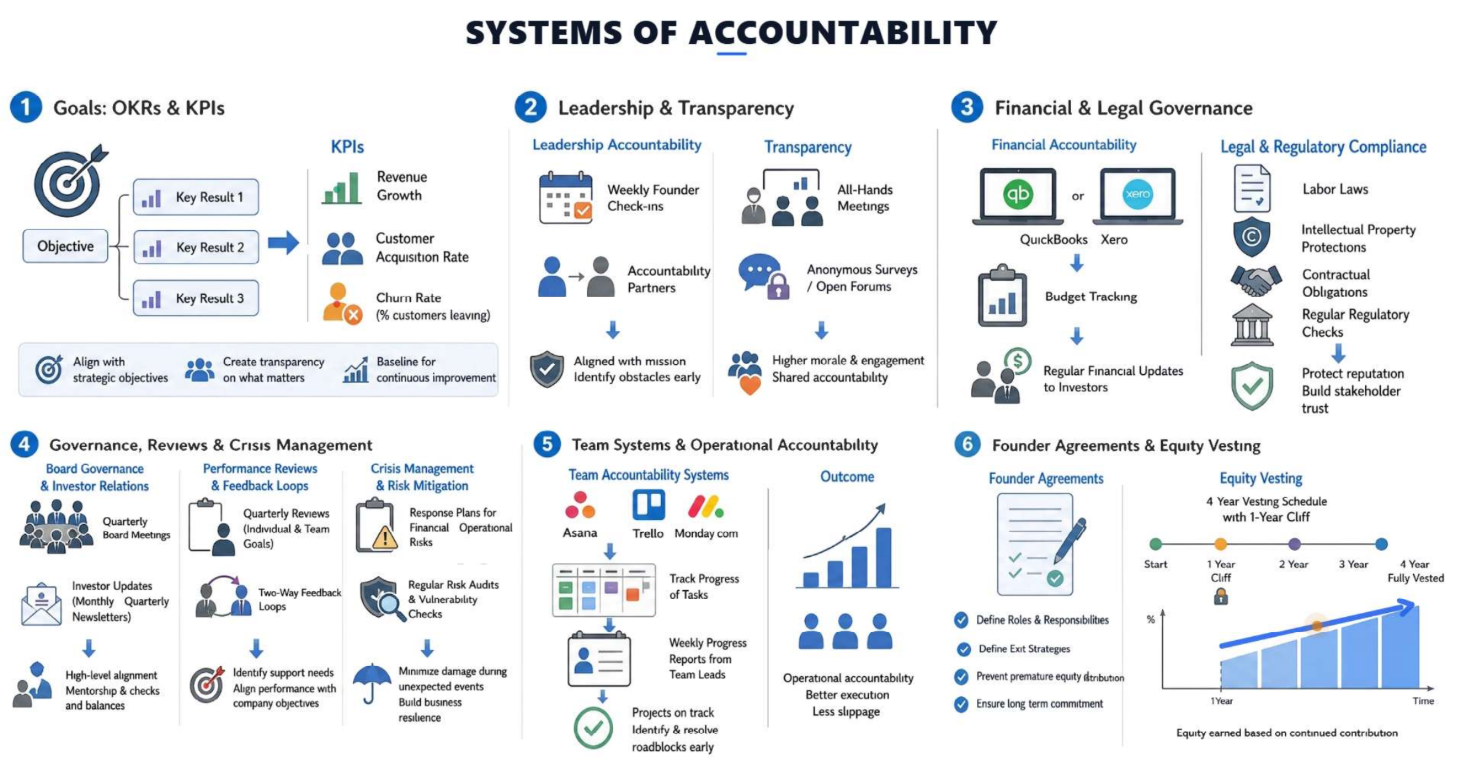
Systems of Accountability The survival of a startup often hinges not on the brilliance of an initial idea, but on the rigor of its execution. Accountability is the mechanism that transforms abstract vision into operational reality by embedding responsibility into every layer of the organization. Establishing Clear Goals Using OKRs and KPIs: Establishing clear goals begins with defining Objectives and Key Results, known as OKRs. You can think of the Objective as the target we are aiming for, it defines our ambitious, high-level goals. But a goal alone isn't enough; we need to break it down. That's where Key Results come in, providing the actionable, measurable steps to get there. While OKRs provide the "where" and "how," we also use Key Performance Indicators to track the "how well" through quantifiable metrics. These metrics typically include things like revenue growth, customer acquisition rates, and churn rates, which measures the percentage of customers who stop using a service over a specific period. By implementing both, a team ensures its efforts are aligned with strategic objectives. Leadership and Transparency: Accountability must originate at the top. Founders are responsible for holding themselves and their executive teams to established standards. This includes structured frameworks like Weekly Founder Check-ins to review priorities, as well as the use of Accountability Partners to report on progress and identify roadblocks. This internal accountability is supported by a broader culture of transparency, maintained through regular all-hands meetings and dedicated feedback channels like anonymous surveys. This approach increases team morale by making accountability a shared responsibility. Financial and Legal Governance: Financial and Legal Governance are the non-negotiable foundations of a sustainable business. Financial accountability requires the implementation of systems for rigorous tracking and reporting, using software that allows for precise budget tracking to build investor confidence. Parallel to this is legal and regulatory compliance. Startups must remain compliant with labor laws, intellectual property protections, and contractual obligations. These practices protect the company's reputation. Governance, Reviews, and Crisis Management: Effective board governance ensures strategic alignment through quarterly board meetings. Beneath the board level, continuous improvement is driven by regular performance reviews and feedback loops. To protect these operations from external shocks, startups must implement crisis management strategies, involving response plans for financial or operational risks. Team Systems and Operational Accountability: We maintain momentum using practical tools. Project management platforms track the progress of specific tasks. When combined with weekly progress reports, these tools keep projects on track and allow early resolution of roadblocks. Finally, long-term stability is protected through Founder Agreements and Equity Vesting. Founder agreements clearly define roles, responsibilities, and exit strategies. Importantly, equity should be earned based on continued contribution. A standard schedule often features a one-year cliff, meaning you must remain with the company for at least one year before earning equity, and then it typically vests over a span of four years. Integration and Discipline: By integrating these layers of accountability, from high-level board governance down to individual vesting schedules, a founder moves from managing a group of individuals to leading a disciplined organization capable of sustained growth.
Objective and Key Results (OKRs) and Key Performance Indicators (KPIs) help set clear goals and measurable outcomes for both founders and team members.
Founders must hold themselves and their executive teams accountable. Implement structured frameworks for accountability.
Transparency fosters trust and collaboration. Encourage open communication throughout the organization.
Proper financial governance is non-negotiable for startups. Implement systems for tracking and reporting finances.
Startups must remain legally compliant in all areas, including labor laws, contracts, and intellectual property.
Effective board governance ensures strategic alignment and accountability.
Continuous improvement requires regular performance evaluations.
Prepare for the unexpected by creating action plans for financial, operational, and reputational risks.
Use project management tools to track progress and foster accountability.
Protect your startup by ensuring equity is earned based on contributions.